
Preventing Silent Data Corruption in Modern Systems
In enterprise systems engineering, there is a dangerous assumption that once data is written to a storage medium, it will be read back exactly as it was saved. This assumption underpins the design of many traditional IT infrastructures. However, at the microscopic level of magnetic platters and NAND flash gates, data is incredibly fragile. Physical wear, electrical interference, and environmental anomalies constantly threaten the integrity of stored digital information.
While catastrophic hardware failures—like a physically shattered hard drive or a burnt motherboard—are immediately obvious and trigger instant failovers, there is a far more insidious threat: Silent Data Corruption. Also known as “bit rot,” silent data corruption occurs when individual bits of data randomly flip from a 1 to a 0 (or vice versa) without the operating system, the storage controller, or the hardware itself ever detecting the change. By the time an administrator realizes that a critical database table is corrupted or an archival video file refuses to play, the damage is already done, and the corrupted data has likely been replicated to the backup servers. Preventing this invisible threat requires a comprehensive strategy encompassing specialized hardware, network-level error correction, and self-healing file systems.
The Mechanics of Silent Data Corruption
To defend against silent data corruption, systems engineers must first understand the physical and logical mechanisms that cause it. Bit rot is not a theoretical concept; it is a measurable statistical inevitability in large-scale storage environments.
Environmental Factors and Cosmic Radiation
At the silicon level, data is stored as microscopic electrical charges. As hardware manufacturing processes shrink to 5-nanometer and 3-nanometer architectures, the electrical tolerances required to distinguish a “1” from a “0” become incredibly tight. One of the most documented causes of random bit flips is cosmic radiation. High-energy neutrons generated by cosmic rays can strike a memory module or a storage controller, discharging the microscopic capacitor and flipping the bit. While this sounds like science fiction, hyper-scale cloud providers document thousands of these radiation-induced memory errors daily across their global data centers.
Magnetic Degradation and Flash Cell Wear
On traditional mechanical Hard Disk Drives (HDDs), silent corruption often stems from magnetic degradation over time. The magnetic domains on the platter that represent bits can slowly lose their orientation, eventually causing a read error. Furthermore, minor physical imperfections on the disk, vibrations in the server rack, or sudden temperature fluctuations can cause the read/write head to slightly misalign, writing data onto adjacent tracks—a phenomenon known as “off-track writing.”
In Solid State Drives (SSDs), silent corruption is primarily driven by the physical wear of NAND flash cells. Every time data is written to or erased from an SSD, the insulating oxide layer surrounding the floating gate degrades slightly. Over years of heavy enterprise use, these gates begin to leak electrons. If enough electrons leak, the storage controller will misinterpret the voltage level, reading a different binary value than what was originally stored.
Error Detection and Correction Protocols
Mitigating silent data corruption requires layers of defensive protocols designed to mathematically verify data integrity both while it is processing in memory and while it is traversing the network.
ECC Memory: The First Line of Defense
The absolute foundation of enterprise data integrity is Error-Correcting Code (ECC) Memory. Standard consumer desktop RAM has no mechanism to know if a bit has flipped due to a neutron strike or electrical interference. If a flipped bit alters a critical system file, the server will crash (a Blue Screen of Death). Worse, if it alters a financial database value, the system will seamlessly save the corrupted value to the disk.
ECC RAM contains an additional memory chip on the module dedicated exclusively to storing parity information. When the CPU writes a 64-bit word to memory, it calculates a 7-bit or 8-bit checksum and stores it in this extra chip. When the data is read back, the memory controller recalculates the checksum. If a single bit has flipped, the controller uses the parity data to mathematically correct the error on the fly, before the operating system even realizes it happened (Single-Bit Error Correction). If two bits flip simultaneously, the system cannot correct it, but it will immediately halt the system to prevent corrupted data from being written to storage (Double-Bit Error Detection). Deploying a production database or storage server without ECC RAM essentially guarantees eventual silent corruption.
Network-Level Integrity: Checksums and CRCs
Data is also highly vulnerable while in transit across Ethernet cables and fiber optics, where electromagnetic interference (EMI) or faulty transceiver optics can corrupt packets. Modern networks rely on the Frame Check Sequence (FCS) at Layer 2 and various checksums at Layer 3 and Layer 4 to verify integrity.
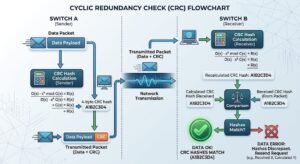
When a switch transmits an Ethernet frame, it runs a mathematical algorithm called a Cyclic Redundancy Check (CRC) across the data payload and appends the resulting hash to the end of the frame. The receiving switch performs the exact same mathematical calculation. If the resulting hash does not match the appended FCS, the switch instantly drops the corrupted frame, forcing the higher-level protocols (like TCP) to retransmit the data. This guarantees that corrupted data does not successfully traverse the network and write itself to an endpoint storage array.
Storage Layer Vulnerabilities and the RAID Illusion
While ECC memory and network checksums protect data in motion, the most critical vulnerability lies at the storage layer, where data sits at rest for months or years. Many administrators mistakenly believe that hardware redundancy provides data integrity.
The Limitations of Hardware RAID
Hardware RAID (Redundant Array of Independent Disks) provides fault tolerance against a complete physical drive failure, but it is entirely blind to silent data corruption. If a sector on a hard drive slowly succumbs to magnetic bit rot, the RAID controller is unaware.
When a user requests a file, the hard drive reads the silently corrupted data and sends it to the RAID controller. Because the RAID controller assumes the hard drive is healthy (since it hasn’t completely failed), it passes the corrupted file directly to the user. Furthermore, if the array is mirrored (RAID 1), the controller may actually overwrite the healthy copy of the file with the corrupted copy during a synchronization event. RAID provides uptime; it does not verify cryptographic integrity.
Next-Generation Integrity: Self-Healing File Systems
To truly eradicate silent data corruption at the storage layer, the IT industry has moved away from legacy architectures and embraced next-generation, self-healing file systems like ZFS (Zettabyte File System) and Btrfs. These file systems do not trust the underlying hardware; they assume that hard drives will inevitably return corrupted data.
Cryptographic Hashing and Merkle Trees
In a standard file system like NTFS or ext4, data is simply written to the block. In ZFS, every single block of data is cryptographically hashed (using algorithms like SHA-256) before it is written to the disk. These checksums are not stored alongside the data block; they are stored higher up in the directory structure, creating a massive, interconnected Merkle Tree.
When an application requests to read a file, ZFS reads the data block from the disk and simultaneously calculates its hash. It then compares this newly calculated hash against the original hash stored securely in the parent metadata. If the hashes match, the data is verified as 100% accurate. If the hashes do not match, ZFS instantly knows that silent data corruption has occurred on the physical disk.
Autonomous Data Scrubbing and Healing
Detection is only half the battle. Because ZFS is fundamentally aware of the underlying RAID structure (unlike traditional hardware RAID, where the file system and the RAID controller are separate entities), it can autonomously execute a self-healing protocol.
Upon detecting a checksum mismatch, ZFS will silently reach out to the redundant parity drive in the storage pool. It calculates the missing data, reconstructs the corrupted block in ECC memory, serves the corrected file to the user without any application delay, and permanently rewrites the correct data back onto the faulty physical drive. Furthermore, administrators can schedule routine “Data Scrubs”—where the file system autonomously reads every single block of data on the array in the background, verifying checksums and repairing bit rot before a user even attempts to access the file. This end-to-end cryptographic verification ensures absolute data fidelity over decades of long-term storage.
Frequently Asked Questions
1. What is bit rot?
Bit rot, or silent data corruption, is the slow deterioration of storage media or the random flipping of microscopic data bits caused by environmental factors, cosmic radiation, or physical wear. It happens silently without alerting the operating system or storage controller, leading to unreadable files and corrupted databases.
2. Will standard SSDs prevent silent data corruption?
No. While modern Enterprise SSDs have internal error correction (ECC) within the NAND flash controller to handle normal cell wear, they are not immune to firmware bugs, controller crashes, or memory bit flips. A self-healing file system like ZFS is still required to guarantee 100% end-to-end data integrity.
3. Is ECC RAM strictly necessary for a home or small business NAS?
Yes. If you are building a storage server using a file system like ZFS, ECC RAM is highly recommended. Because ZFS uses system memory to calculate cryptographic checksums and execute self-healing repairs, a bit flip in non-ECC RAM could theoretically cause the file system to write corrupted parity data to the drives, compromising the entire storage pool.
4. Does cloud storage suffer from silent data corruption?
Physically, yes, the hardware in AWS or Azure data centers experiences bit rot just like local servers. However, hyper-scale cloud providers utilize massive object storage architectures with aggressive, continuous background data scrubbing, cryptographic hashing, and triple-redundancy protocols that automatically detect and heal corruption before it ever impacts the end-user.
Authoritative Sources & References
-
CERN Information Technology Department: Studies on Data Corruption and Cosmic Ray Induced Bit Flips
-
Storage Networking Industry Association (SNIA): End-to-End Data Protection and Integrity
-
OpenZFS Documentation: Cryptographic Checksumming and Self-Healing Mechanisms
-
IEEE Xplore: An Analysis of Silent Data Corruption in Large-Scale Enterprise Storage Environments