
Storage Controllers and Their Impact on Performance Consistency
A crucial component—often overlooked by users—sits between the application and the storage device: the storage controller. This hardware or software layer manages data transfer between the system and the storage medium. It determines how requests are processed, how data is organized, and how efficiently storage resources are utilized.
In environments where reliability is critical, consistent performance is often more valuable than occasional performance spikes. Databases, virtual machine platforms, and enterprise applications require predictable responses, not unpredictable performance surges followed by slow load times. Understanding the storage controller helps explain why two systems with similar hard drives can perform drastically differently. The controller’s design, configuration, workload handling, and available features all influence the user experience.
What a Storage Controller Actually Does
A storage controller acts as a communication manager between a computer system and its storage devices. It receives requests from applications, processes those requests, and coordinates how information is written to or retrieved from storage. Without a controller, applications would have to communicate directly with storage hardware and handle many complex operations themselves. Controllers simplify this process by managing technical tasks behind the scenes.
Common responsibilities of storage controllers include:
- Managing data transfers: Controllers organize the that processf information between servers and storage devices.
- Handling RAID operations: They can combine multiple drives to improve performance, reliability, or both.
- Managing cache: Controllers temporarily store frequently accessed data to reduce delays.
- Monitoring storage health: They detect problems and provide information about drive conditions.
- Balancing workloads: They distribute requests efficiently across available storage resources.
The controller does not simply speed up storage. Its main role is to make storage behavior more efficient and predictable.
Why Performance Consistency Matters More Than Maximum Speed
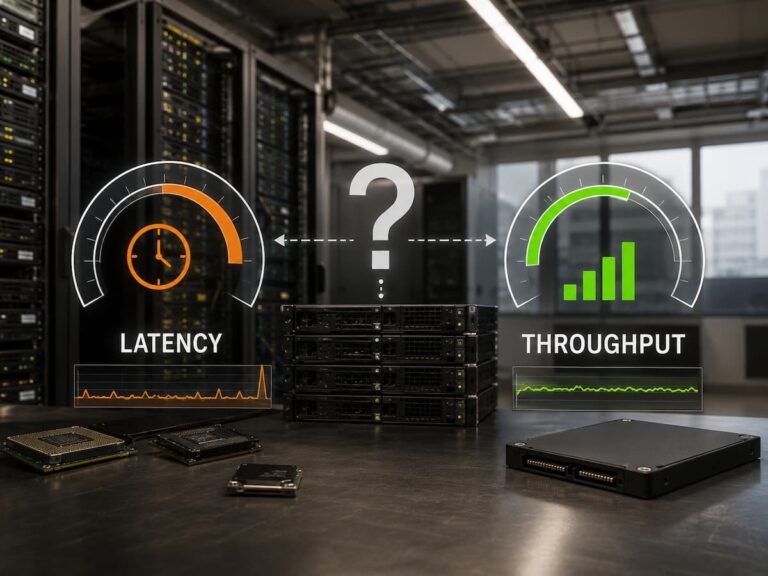
Storage discussions often focus on maximum speed numbers, but real-world performance depends on how consistently a system behaves under different conditions. For example, an online application may perform well when only a few users are active. During busy periods, thousands of requests may arrive at the same time. A storage controller with poor workload management may struggle, causing delays that affect the entire application. Performance consistency means maintaining stable response times even when workloads change. This is especially important for:
- Database systems processing frequent transactions.
- Virtual environments running multiple workloads.
- Business applications requiring predictable access times.
- Servers that handle many simultaneous users.
A well-designed storage controller helps reduce sudden performance drops by managing requests efficiently and preventing storage resources from becoming overwhelmed.
How Storage Controllers Influence Real Performance
Several controller features and decisions affect storage performance. The controller determines how efficiently the storage system responds when applications request information.
1. Cache Management
Cache is one of the most important controller features. It allows frequently accessed information to be temporarily stored in faster memory so future requests can be completed more quickly. A controller with effective cache management can reduce delays during repeated operations. However, poor configuration can create problems. For example, if a power failure occurs, it could cause the loss of important information that cached data does not properly protect.
2. RAID Processing
Many storage controllers manage RAID configurations, where multiple drives work together as a single storage system. RAID can improve availability and performance, but the controller must efficiently manage the additional processing requirements. When RAID operations are handled poorly, the controller can become a bottleneck even if the storage drives themselves are capable of higher performance.
3. Queue Management
Modern systems often receive many storage requests at the same time. Controllers organize these requests into queues and decide the most efficient order for processing them. Effective queue management helps prevent applications from experiencing unnecessary delays during heavy workloads.
Hardware Controllers vs. Software Controllers
Storage controllers can be implemented through dedicated hardware or managed through software. Each approach has different advantages depending on the environment.
| Controller Type | How It Works | Common Advantages |
|---|---|---|
| Hardware Controller | A dedicated processor manages storage operations. | Strong performance, dedicated resources, and advanced RAID features. |
| Software Controller | The operating system manages storage functions. | Flexible configuration and lower hardware requirements. |
Hardware controllers are often used in enterprise environments where predictable performance and reliability are priorities. They can handle storage-related tasks without placing additional workload on the main system processor. Software controllers have become more capable as modern operating systems improve. They can provide flexibility and easier management, especially in environments where hardware simplicity is important. The best choice depends on workload requirements, budget, scalability needs, and reliability expectations.
Common Signs of Storage Controller Problems
Storage controller issues are not always obvious because symptoms may appear similar to other hardware or software problems. However, certain warning signs can indicate controller-related limitations.
- Applications become slow during periods of increased activity.
- Storage performance changes unpredictably under similar workloads.
- High latency appears even when storage capacity is available.
- Virtual machines experience inconsistent response times.
- RAID rebuild operations significantly reduce system performance.
Diagnosing these issues requires monitoring more than storage capacity. Administrators need to examine controller utilization, cache behavior, queue depth, and storage response times.
Best Practices for Improving Storage Controller Performance
Maintaining consistent storage performance requires proper planning and ongoing management. A controller that performs well initially may need adjustments as workloads change.
- Monitor performance regularly: Track latency, workload patterns, and controller usage before problems appear.
- Keep firmware updated: Updates can improve stability, compatibility, and performance.
- Choose suitable RAID configurations: Different RAID levels provide different balances between speed and protection.
- Avoid overloading controllers: A controller managing too many devices may become a performance limitation.
- Test under realistic workloads: Performance should be evaluated based on actual usage scenarios.
Conclusion
Storage performance depends on more than selecting fast drives. The controller managing those drives plays a major role in determining how efficiently and consistently data moves through the system. A well-designed storage controller improves reliability by managing requests, reducing delays, supporting protection features, and maintaining predictable performance during demanding situations.
When planning storage infrastructure, organizations should consider the controller as an important part of the overall design rather than a small hardware detail. The right controller choice can influence how well systems perform today and how effectively they handle future growth.
FAQs
1. Can the storage controller become a performance bottleneck?
Yes. If the controller cannot process storage requests quickly enough, it limits the performance of otherwise powerful hard drives and causes system-wide latency.
2. Does a faster storage drive always result in better performance?
Not always. The controller, configuration, workload type, and communication paths between systems all influence actual performance.
3. Why is caching so important for storage controllers?
Caching temporarily stores frequently used information, thereby reducing latency and improving responsiveness during repetitive operations.
4. Are hardware-based storage controllers still useful today?
Yes. Hardware-based controllers remain valuable in many enterprise environments because they offer dedicated processing power, advanced management capabilities, and predictable performance.
5. How can administrators determine if a controller needs improvement?
Monitoring storage latency, workload behavior, controller utilization, and application performance helps determine whether the controller is limiting system performance.