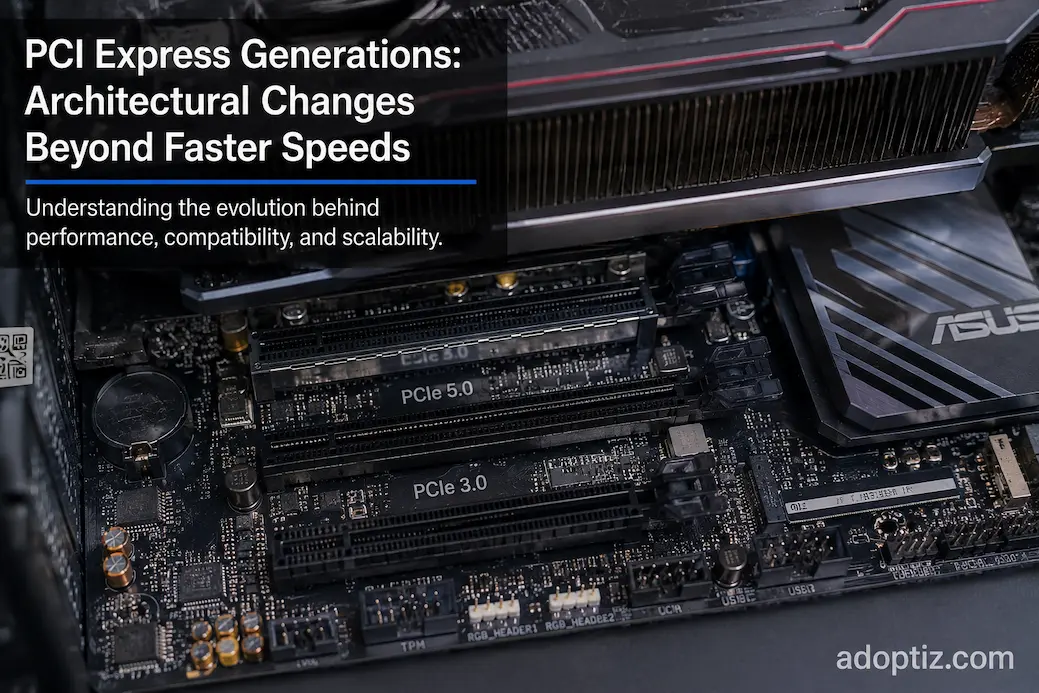
PCI Express Generations: Architectural Changes Beyond Faster Speeds
When the next generation of PCI Express is released, the initial focus is usually on speed. Talk typically centers on “doubled transfer speeds,” “support for faster graphics cards,” or “support for next-generation storage devices.” While these improvements are certainly welcome, they represent only the most visible results of a massive engineering effort.
PCI Express has undergone several iterations, and not simply because computers require more slots. More importantly, modern systems employ more advanced standards for component-to-component communication. Speeds have increased, graphics processors have become more powerful, storage has shifted from mechanical hard drives to high-speed solid-state drives (SSDs), and dedicated accelerators are taking over tasks previously handled exclusively by the CPU. These changes necessitate improvements to the transmission infrastructure connecting a computer’s various components.
Consequently, a new version of PCI Express offers more than just increased speed. Each revision brings changes regarding signal efficiency, data transfer methods, scalability, power consumption, and the ability to build flexible systems. Understanding these architectural improvements helps explain why the new version of PCIe is so significant, even if certain workloads do not immediately benefit from the fastest connection speeds.
PCI Express Is a Communication Architecture, Not Just a Slot
People often mistakenly believe that PCI Express is merely a slot for installing expansion cards. In reality, the slot is just one part of a larger communication mechanism, and the system itself is far more complex.
PCI Express is the standard that enables devices to share data with the processor and other system components. PCIe connections enable graphics cards, network cards, storage controllers, capture cards, and other specialized computer accelerators to easily transmit and receive data.
This connection consists of lanes. Each lane provides a way to transmit and receive data, and multiple lanes can be combined to achieve greater bandwidth. This scalability allows manufacturers to produce various types of devices without having to design entirely new interfaces for every speed level.
For example:
- A lower-bandwidth device may require only one PCIe lane.
- A graphics card may use many lanes to transfer large amounts of data.
- Enterprise accelerators may combine multiple high-speed connections for demanding workloads.
This flexibility has helped PCI Express remain relevant across many generations of computing hardware.
Why Increasing Speed Alone Was Not Enough
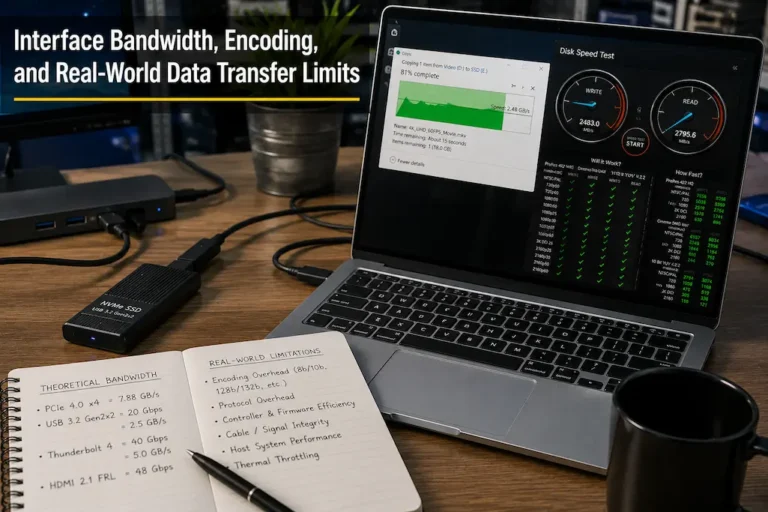
The easiest way to describe PCIe evolution is by looking at bandwidth increases, but bandwidth was only one part of the challenge. Faster communication introduces additional engineering problems that must be solved before higher speeds can be used reliably.
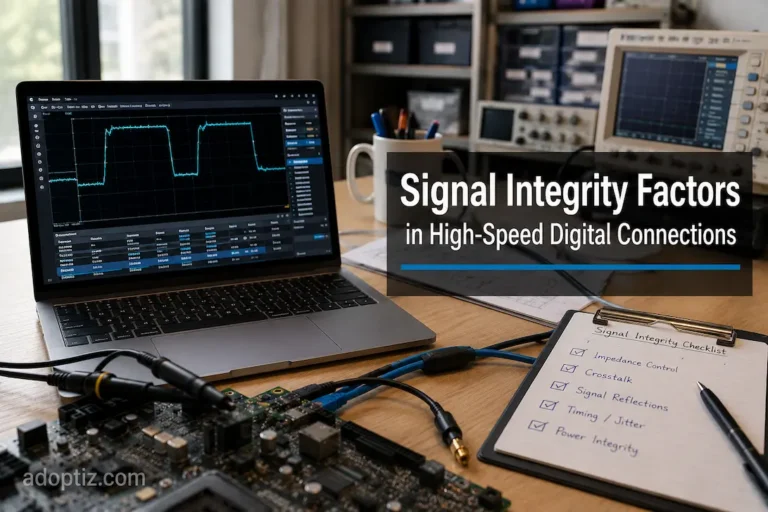
As signaling rates increase, maintaining signal quality becomes more difficult. Electrical interference, physical limitations of circuit boards, connector design, and power efficiency all become increasingly important factors.
A faster interface that produces unreliable communication would not provide meaningful progress. Engineers therefore had to improve several areas simultaneously:
- Signal integrity at higher frequencies.
- Data transmission efficiency.
- Error handling capabilities.
- Power consumption.
- Compatibility with existing systems.
This is why PCI Express generations represent broader architectural improvements rather than simple speed upgrades.
The Evolution of PCI Express Design
Each PCI Express generation built upon the previous version while addressing new technical challenges. Although bandwidth improvements are often highlighted, the underlying changes reflect the industry’s changing requirements.
| PCI Express Generation | Major Architectural Focus | Practical Impact |
|---|---|---|
| Early generations | Establishing scalable serial communication | Replaced older expansion approaches with a flexible high-speed interface |
| Mid-generation improvements | Higher signaling efficiency and bandwidth growth | Supported increasingly powerful graphics and storage devices |
| Recent generations | Greater throughput, improved efficiency, and advanced workloads | Enabled faster SSDs, GPUs, and specialized accelerators |
The important lesson is that PCIe evolution was not driven by one type of device. Different technologies pushed the interface forward at different times.
Graphics processing demanded more bandwidth for increasingly complex workloads. Storage pushed the limits because modern SSDs could process data far faster than previous interfaces allowed. Artificial intelligence and professional compute workloads introduced new requirements for accelerators that exchange large amounts of data with the rest of the system.
Signaling Improvements Changed How PCIe Scales
One of the most significant areas of PCI Express evolution has been signaling technology. Increasing performance is not as simple as increasing the number of lanes indefinitely. More physical connections increase complexity, consume more space, and create additional design challenges.
Improving how much information can be transmitted through each lane allows PCIe to increase capability while maintaining compatibility with existing concepts.
Each generation improved the efficiency and reliability of communication, allowing more data to move through the same basic lane structure. This approach has been important because it enables manufacturers to build faster systems without dramatically changing the entire hardware ecosystem.
Why Signal Quality Becomes Harder at Higher Speeds
As transmission speeds increase, electrical signals become more sensitive to imperfections. Small variations that were insignificant at lower speeds can create communication errors at higher rates.
Engineers address these challenges through improvements in areas such as:
- Better signal management.
- Improved transmission techniques.
- More advanced error detection.
- Careful motherboard and connector design.
These changes often remain invisible to users, but they are essential for making each new PCIe generation practical.
More Bandwidth Does Not Automatically Mean Better Performance
One of the biggest misconceptions surrounding PCI Express is that upgrading to a newer generation always produces a noticeable performance improvement. In reality, the benefit depends heavily on whether the connected device and workload can actually use the additional bandwidth.
A graphics card performing a workload that already fits comfortably within an older PCIe connection may show little difference when moved to a newer generation interface. Similarly, many everyday applications do not continuously transfer enough data to take advantage of the maximum available bandwidth.
However, some workloads are far more sensitive to PCIe improvements.
Examples include:
- Large-scale data transfers.
- High-performance storage operations.
- Multi-GPU or accelerator-based computing.
- Professional workloads involving massive datasets.
The interface matters most when communication between components becomes a limiting factor.
Engineering Insight
A recurring mistake in hardware discussions is treating interface bandwidth as equivalent to application performance. In practice, communication speed is only one part of the equation. A faster connection helps most when the workload is already limited by data movement between components.
PCI Express Generations and the Changing Role of Expansion Devices
As expansion cards have become more advanced and specialized, the importance of PCI Express has grown. Early computers featured expansion slots primarily used for graphics cards and a few other devices. PCIe is an essential component of modern systems, as it enables communication between a wide range of functions and components.
This evolution has changed how engineers approach future growth. A PCIe connection is no longer merely a port for attaching extra hardware; it is now integrated into the system’s overall operation to boost speed.
High-speed storage solutions offer a clear example of this shift. Older storage devices were often constrained by outdated connection technologies or mechanical limitations. Modern solid-state drives (SSDs), however, can process data at speeds where the communication interface itself becomes the limiting factor. Thanks to improvements in PCI Express, storage technology can continue to evolve without requiring an entirely new transfer standard.
The same applies to graphics processors and other specialized accelerators. As these devices became more powerful, the ability to rapidly move data between the processor, memory, and expansion hardware became increasingly critical.
Latency, Efficiency, and Workload Behavior Matter Alongside Bandwidth
Although discussions about PCI Express often focus on bandwidth, it is not the only factor determining real-world speed. Performance depends on how data flows through the system, the efficiency of communication, and how workloads utilize the interface.
Additional bandwidth can be highly beneficial for a device that transmits massive amounts of data. However, for workloads consisting of many small transactions, factors such as latency, communication efficiency, and software optimization are often more important.
This explains why two devices using the same PCIe generation can still yield different speed results. The interface enables communication, but the outcome depends on how effectively the hardware and software utilize that capability.
For instance, a professional data processing system handling very large datasets can benefit enormously from a newer PCIe generation. In contrast, the impact on a standard office task would be limited, as performance in that context is determined more by factors such as processor speed, application design, or memory behavior.
Backward Compatibility Has Been One of PCIe’s Greatest Strengths
One reason PCI Express has remained successful for so long is its approach to compatibility. Newer PCIe devices are generally designed to work with older generations, allowing gradual upgrades instead of requiring complete platform replacements.
This compatibility model provides flexibility for both manufacturers and users. A newer graphics card may operate in an older motherboard, and an older expansion device may continue functioning in a newer system, although the available performance may be limited by the older connection standard.
This approach creates a practical upgrade path:
- Users can replace individual components instead of entire systems.
- Businesses can introduce newer hardware gradually.
- Manufacturers can continue supporting a large ecosystem.
However, compatibility also introduces complexity. A device may physically fit into a slot but operate at a reduced capability because the system, motherboard, or processor supports an older PCIe generation.
Understanding the Real Limitation
When compatibility issues appear, the limitation is not usually whether devices can communicate. The more important question is whether the connection provides enough capacity for the intended workload.
A high-performance device running on an older PCIe connection may still function correctly, but the available bandwidth could prevent it from reaching its maximum potential.
PCI Express Evolution Reflects Changing Computing Priorities
The development of PCI Express mirrors broader changes in computing. As computers became more specialized, the communication layer connecting different components became increasingly important.
Modern systems are no longer defined only by the processor. Performance increasingly depends on how effectively multiple components work together:
- CPUs coordinate with accelerators.
- GPUs process increasingly complex workloads.
- Storage systems handle larger datasets.
- Network devices operate at higher speeds.
PCI Express provides the foundation that allows these different technologies to communicate efficiently.
This is why PCIe evolution should not be viewed only as a series of bandwidth upgrades. Each generation represents an attempt to keep the communication infrastructure aligned with the changing demands of computing.
Future Challenges: Scaling Beyond Speed
Future PCI Express development will continue facing many of the same challenges that shaped previous generations. Increasing bandwidth sounds straightforward, but each improvement requires careful engineering to maintain reliability, efficiency, and compatibility.
Higher speeds create greater demands on:
- Motherboard design.
- Signal integrity management.
- Power efficiency.
- Thermal considerations.
- Manufacturing precision.
At the same time, future computing workloads may place new demands on PCIe that are not simply solved by increasing transfer rates. Artificial intelligence systems, specialized accelerators, and increasingly distributed computing architectures may require improvements in efficiency, flexibility, and data movement strategies.
The future of PCI Express will therefore depend not only on how much data can move through a connection but also on how intelligently that communication is managed.
Choosing Hardware Based on Real Requirements
When selecting hardware, PCI Express generation should be considered as part of a larger system design rather than as an isolated specification.
A newer generation can provide valuable advantages, but those benefits depend on the workload, connected devices, and overall platform configuration.
A sensible evaluation approach includes asking:
- Does the connected device actually require additional bandwidth?
- Is the workload limited by data transfer speed?
- Will future upgrades benefit from additional PCIe capacity?
- Does the rest of the system support the intended performance level?
This prevents a common mistake: paying for interface capability that the workload cannot use.
A balanced system is usually more effective than one built around the highest available specification. PCI Express is an important part of performance, but it works together with processors, memory, storage, software, and workload design.
FAQs
1. Why introduce a new generation of PCI Express when most devices do not require extra bandwidth?
The new generation of PCI Express was developed because certain workloads eventually surpassed the capabilities of older versions. While everyday applications may not show an immediate performance boost, high-performance storage, professional graphics applications, networking, and dedicated computing tasks typically require greater communication bandwidth.
2. Can PCIe Gen 5 devices be used with PCIe Gen 4 interfaces?
In most cases, PCI Express maintains forward and backward compatibility, meaning different versions of devices can work together. However, the speed of a device is usually limited by the speed of the slowest compatible device in the connection.
3. Does a newer generation of PCI Express automatically improve gaming performance?
No. Gaming performance depends on many factors, such as GPU performance, processor speed, memory, and game optimization. A newer PCIe connection only improves performance when the workload is limited by communication bandwidth.