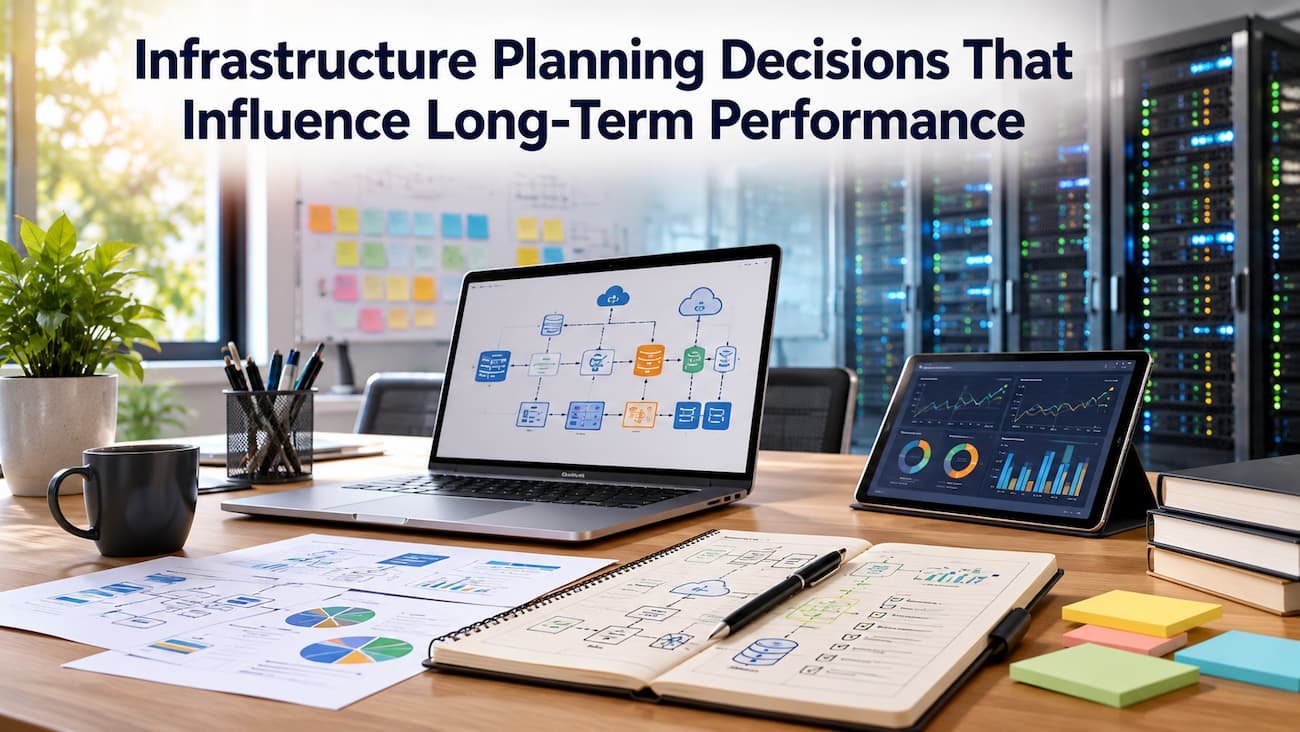
Infrastructure Planning Decisions That Influence Long-Term Performance
Infrastructure planning is like laying a foundation. A poorly designed foundation leads to high maintenance costs and operational disruptions down the line. The same applies to the technology environment. A system’s ability to adapt easily to business needs depends on the choices made regarding architecture, capacity, security, and management.
Powerful hardware is not the only factor determining long-term performance. As workloads increase, a well-planned infrastructure must remain reliable, manageable, and flexible. It needs to support new applications without requiring a redesign. Effective planning does not require precise predictions about the future; rather, it involves building an environment capable of handling uncertainty while ensuring low maintenance costs and ease of upkeep.
Early Infrastructure Choices
Many infrastructure decisions have a lifespan that extends beyond that of specific applications. Software tools may be replaced after a few years, but the underlying systems often last much longer. That is why early decisions are crucial. Poor infrastructure planning can create permanent limitations. A network that works well for a small team might collapse when the number of employees, cloud services, and connected devices reaches the hundreds. These problems typically arise gradually.
During peak periods, performance may drop, the maintenance burden may increase, and administrators may spend more time correcting errors stemming from earlier decisions. Effective infrastructure planning balances current needs with future system changes. The goal is not to build the largest possible environment, but to lay a solid foundation that is easily scalable.
Capacity Planning Ahead of Growth can be stressful
Understanding future capacity requirements is crucial for infrastructure decisions. Companies often focus solely on immediate needs, underestimating the rate at which data, users, and workloads grow. Capacity planning involves analyzing usage patterns and forecasting infrastructure requirements, including computing power, storage, network capacity, and system performance.
Under-planning capacity can lead to problems. Systems may slow down, applications may experience latency, and teams may urgently require improvements. Conversely, over-planning capacity can result in the waste of valuable resources. Maintaining manageable flexibility in infrastructure design is the best approach. This might include, for example, scalable storage, a scalable network design, or a platform capable of increasing computing power as demand grows. Capacity planning should not rely on assumptions about data for the years ahead. By offering multiple options, organizations can adapt to a constantly changing environment.
Choosing an Adaptive Architecture
The structure of your infrastructure environment impacts future performance. System communication, resource management, and change management all depend on your architectural choices. Highly integrated systems may initially appear efficient because all components work together. However, as the ecosystem evolves, tightly coupled designs become difficult to adapt, as modifying one component can affect several others.
Flexible designs isolate critical functionalities for improvement or replacement. Separating storage, application services, and networking simplifies upgrades. Yet, such an approach does not mean every company should choose the most complex architecture. Complexity creates obstacles. The best design offers sufficient flexibility while ensuring the maintenance team can understand it.
The Importance of a User-friendly Design
A technically advanced system can be difficult to manage. Long-term performance depends on how easily administrators can monitor, troubleshoot, and maintain the infrastructure. Simple designs perform better in the long run because issues are easier to detect. Administrators who understand system connectivity can respond quickly to problems.
Complex environments may require specialized knowledge to perform basic tasks. This increases reliance on specific personnel and complicates day-to-day maintenance. Ease of use does not mean removing useful features. The goal is to avoid complexity and opt for solutions that add value. Every new component requires security, monitoring, updates, and support.
Performance, Costs, and Future Flexibility
Infrastructure planning often involves trade-offs. Organizations have limited budgets, manpower, and time. Finding a design that performs well and is both financially and operationally viable is challenging. High-performance equipment may deliver excellent results, but if users rarely use it, they waste resources. Conversely, opting for lower-performance equipment can stifle growth and lead to costly upgrades.
Effective infrastructure planning takes the entire lifecycle into account; the initial purchase price is just one component. Maintenance, energy consumption, management, security updates, and expansions all impact long-term costs. A balanced approach prioritizes value over price or specifications. The optimal infrastructure choice supports business objectives while allowing for future adjustments. Growing organizations may find scalable cloud solutions more suitable than purchasing large quantities of hardware upfront, whereas companies with predictable workloads might benefit from dedicated infrastructure. The right choice is dictated by reality, not trends.
Technological Changes Must Influence Planning
Infrastructure construction is inextricably linked to technological development. New software, security measures, automation technologies, and business models can alter an organization’s system requirements. Building infrastructure that meets only current technological needs—without the ability to adapt to future developments—is a classic planning error. When new requirements arise, earlier design decisions can constrain organizations.
Forward-looking planning is not about predicting every technological advancement but about building flexible systems. Flexible resource management, modular architecture, and a robust documentation environment enable organizations to adapt without having to start from scratch. This approach is highly effective because technologies evolve at different rates. Software requirements evolve much faster than server platforms (which may have a lifespan of several years). Infrastructure must accommodate these layers without hindering their operation.
Documentation and Governance Impact Long-term Performance
Technological choices and environmental management influence infrastructure performance. Documentation and governance are sometimes overlooked because they do not yield immediate performance gains, yet they significantly enhance long-term stability. Clear documentation helps teams better understand system configurations, decision-making processes, and component dependencies. Without this information, the risks associated with changes increase, and troubleshooting takes longer.
Governance mechanisms establish standards for infrastructure management. These may include change approvals, security setting reviews, performance monitoring, and upgrade planning. These mechanisms become increasingly effective as the business grows. Individual knowledge may suffice for small environments, but large systems require structured information that multiple people can manage.
Maintenance Planning
Infrastructure planning must also encompass the post-implementation phase. Many systems function well initially but become inefficient over time due to neglected maintenance. Monitoring hardware, updating software, assessing security measures, and adapting to changing performance requirements are all crucial. If you neglect a system after installation, it can become obsolete or unusable.
Maintenance planning requires a realistic timeline for upgrades, replacements, testing, and evaluations. It is also essential to understand which components are most critical and which aspects take priority. Developing maintenance plans early on helps avoid emergency decisions. Improvements can be implemented in phases to minimize disruption, rather than simply replacing failed systems.
Long-term Infrastructure Planning Methods
Imagine a company developing a customer management platform. Initially, the organization has a small user base and a limited volume of data, making a simple infrastructure seem sufficient. A short-term strategy might prioritize immediate needs and opt for the least expensive option. However, a few years later, the company anticipates growth in customer numbers, data storage requirements, and connected services.
A more advanced planning strategy anticipates future needs. The organization would choose a system with scalable storage, decouple critical services, establish clear monitoring mechanisms, and document the architecture. Although the initial investment requires more preparation, the company can avoid large-scale redesigns as it grows. Infrastructure should support business growth, not hinder it.
Common Planning Mistakes
Decisions based on short-term needs can lead to infrastructure problems. Quick fixes might solve the immediate issue but can have more serious consequences later. A common mistake is ignoring scalability. The system may work well initially, but its scalability will diminish as usage increases. Planning for growth can prevent costly redesigns.
Choosing technology solely based on specifications is another common mistake. A powerful solution may not be ideal if it increases complexity, requires specialized skills, or necessitates complex management. Organizations sometimes underestimate integration requirements. New systems must integrate with existing applications, security systems, and operational processes. A solution that appears sound in isolation can cause problems on a larger scale.
Improve Future Infrastructure Decisions
Sound infrastructure planning requires long-term decision-making. The optimal environment is not necessarily new or expensive; rather, it is built with future needs in mind. Effective planning demands both technical and business skills, alongside an assessment of performance, reliability, cost, security, and adaptability.
Decisions regarding instrumentation may seem highly technical, yet their impact is far-reaching. They influence an organization’s responsiveness, team efficiency, and confidence in seizing new opportunities. By prioritizing flexibility, maintainability, and thoughtful design, companies can build infrastructure that delivers long-term value well beyond the initial decisions.
FAQs
1. Why is designing the infrastructure before building a system crucial?
Planning helps companies anticipate future growth, maintenance needs, security requirements, and operational issues before they build systems, which helps them avoid costly limitations.
2. Does a larger budget always mean better infrastructure?
Not necessarily. Good infrastructure results from making the right decisions based on actual needs. A well-designed system typically offers greater long-term value than an expensive but poorly built environment.
3. How can companies prepare their infrastructure for future growth?
Opt for a scalable design, monitor usage patterns, document systems, and conduct regular evaluations to ensure the infrastructure can adapt to future growth and meet changing needs.
4. Why should we aim for a simple infrastructure design?
In general, simpler systems are easier to monitor, troubleshoot, secure, and manage. Reducing complexity enables teams to better manage the growing infrastructure.
5. How often should infrastructure planning be reviewed?
Infrastructure evaluations should be conducted regularly and whenever significant business changes occur—such as expansion, the introduction of new applications, changes in security requirements, or major technology upgrades.
References
- National Institute of Standards and Technology (NIST) — Cybersecurity Framework:
https://www.nist.gov/cyberframework - National Institute of Standards and Technology (NIST) — Cloud Computing Standards and Guidance:
https://www.nist.gov/programs-projects/cloud-computing - International Organization for Standardization (ISO) — Information Technology Service Management Guidance:
https://www.iso.org/ - Cloud Native Computing Foundation (CNCF) — Cloud Native Infrastructure Resources:
https://www.cncf.io/