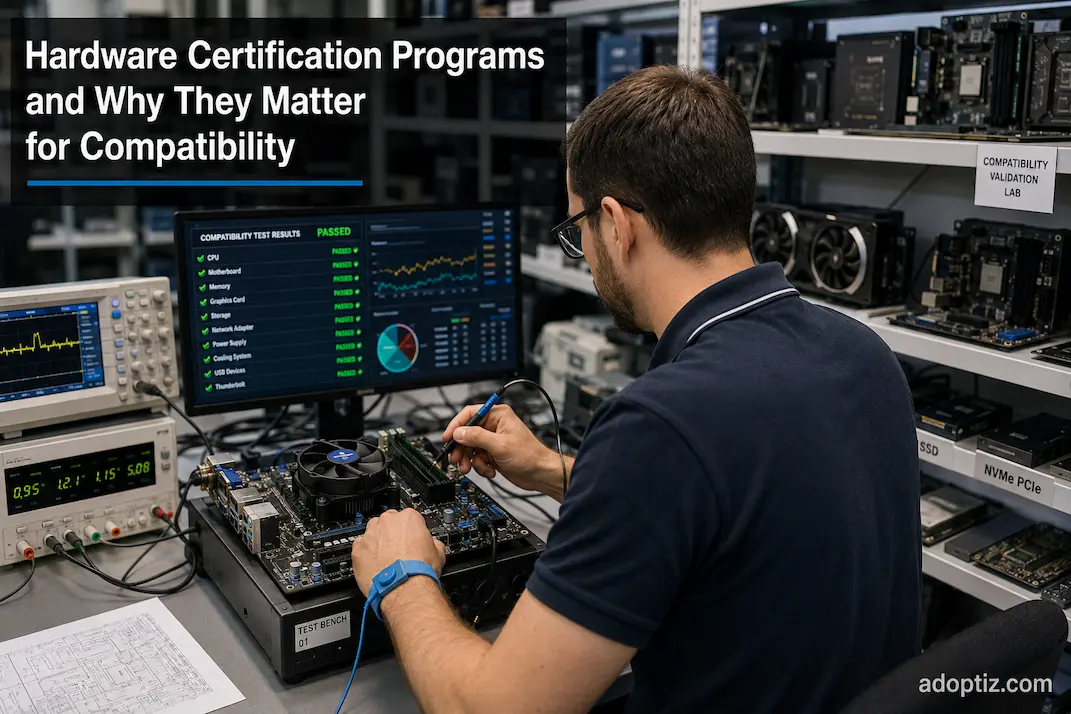
Hardware Certification Programs and Why They Matter for Compatibility
Modern hardware rarely functions as a standalone component. Computer systems are composed of devices from various manufacturers, each with its own design choices, firmware, software support, and internal engineering processes. The processor must communicate with the motherboard, storage devices must communicate with the controller, peripherals must connect to the operating system, and all components must work together to form a complete system.
This level of cooperation does not happen automatically.
Hardware certification systems exist to ensure that products meet specific technical requirements before reaching users. Certification is not merely about manufacturers claiming their products meet standards; it introduces a process of testing, evaluating, and verifying hardware against predefined standards.
As the technology ecosystem grows increasingly complex, the importance of certification rises. Modern devices may need to support multiple generations of hardware, communicate with diverse software environments, and function reliably for years. Without formal verification, compatibility issues would occur more frequently and be harder to detect.
Certification does not guarantee that every hardware combination will work correctly, but it lays the groundwork for reducing ambiguity and improving interoperability between different, independently developed technologies.
Why Hardware Compatibility Is More Complicated Than It Appears
Compatibility seems simple: two devices either work together or they don’t. However, modern hardware compatibility requires coordination at multiple levels.
A component may need to meet physical, electrical, software-related, and operational requirements to function properly.
A device might have the necessary connectors yet fail to work because the communication protocol is unsupported. It might support the correct protocol but still cause problems because the firmware behaves differently than expected. It may work perfectly during initial installation but subsequently fail to function after a software update alters the way the system communicates.
This complexity means that hardware manufacturers cannot rely solely on basic standards.
Two products may claim to support the same technology, yet the actual quality of the implementation can vary significantly. Certification programs help bridge this gap by ensuring that products meet more precise requirements than mere claims of basic compatibility.
The Difference between Standards and Certification
Standards lay the foundation for how technology operates. They define technical specifications such as communication protocols, electrical characteristics, performance targets, and safety guidelines.
However, standards do not always guarantee that the final product will be used correctly.
Certification provides additional assurance by assessing the hardware’s conformity to specifications. It determines whether a product meets the applicable rules and functions correctly in its intended environment.
This distinction is crucial because many compatibility issues do not stem from flaws in the standards themselves, but rather from problems that arise during implementation.
Standards create a common language for manufacturers. Certification ensures that devices can communicate correctly with one another using this language.
How Certification Testing Secures the Hardware Ecosystem
The hardware ecosystem is built on trust between various companies and technologies. Motherboard manufacturers need to be confident that their expansion devices will function correctly. Peripheral manufacturers need to trust that the operating system will correctly recognize their products. Companies deploying large numbers of devices require predictable results.
Certification programs aim to strengthen this trust by developing controlled testing methods.
Depending on the type of hardware being certified, the testing process can cover a wide range of areas. This may include communication reliability, power consumption, signal quality, performance requirements, and interaction with supporting software.
The goal is not merely to confirm that the device powers on; it is to assess whether the device operates stably in real-world scenarios. This strategy improves the entire technology ecosystem by identifying issues early, before products are deployed on a large scale.
Why Certification Matters More as Technology Advances
Early computer systems were often easier to understand because each component served a specific purpose. A keyboard connected to one port, a monitor to another, and storage devices used relatively simple communication protocols.
Modern systems are significantly more integrated.
Individual components may require support at multiple levels. High-speed storage devices might require specific motherboard firmware, operating system drivers, controller support, and power management compatibility. Professional graphics equipment may rely on software frameworks, display standards, and specific hardware features.
The risk of compatibility issues is directly proportional to the number of interactions involved.
Certification programs are valuable in these situations because they increase confidence in the ability of different technologies to function together under expected conditions.
Certification Is Not Only About Making Devices Work
A common misconception is that certification is solely about verifying basic functionality. In reality, many certification programs focus on broader goals such as reliability, consistency, and predictability.
Even if a device functions correctly in theory, inconsistency in practice can still lead to problems. For example, a component might work well in one system configuration but fail when used with different firmware versions or operating systems.
Certification helps prevent these issues by requiring manufacturers to meet specific verification standards.
This is particularly important for professional organizations and businesses that typically plan their hardware choices for the long term. They are interested not only in how a device performs on day one but also in its long-term reliability.
The Role of Firmware and Software Verification
Software has an increasingly significant impact on hardware compatibility. Modern components contain firmware that controls internal behavior, manages communication, and enables additional functionality.
Even if a device meets physical specifications, it may fail to function correctly if the firmware or drivers cannot interface properly with the operating system.
Because modern technology is inextricably linked to the underlying software, certification processes typically take these factors into account.
Storage devices, network adapters, graphics cards, and peripherals are no longer merely physical entities; they are part of a broader hardware-software ecosystem.
Consequently, certification testing often goes beyond physical connections to analyze overall system performance during actual use.
Hidden Benefits of Certification for Users
To the average user, certification might seem like nothing more than a technical label with no real practical significance. However, its value becomes apparent when selecting components that must work together seamlessly without extensive troubleshooting.
Certified hardware reduces uncertainty by demonstrating that the device meets specific evaluation criteria.
This does not mean, however, that non-certified products are unreliable by definition; many non-certified products function perfectly well. Certification, on the other hand, provides additional information to help users and organizations understand the product’s level of verification.
In complex hardware configurations, one of the key benefits of certification is its ability to reduce uncertainty.
The Impact of Certification Programs on Long-Term Hardware Support
Hardware compatibility is not just about whether a device works immediately after installation. Often, the most important consideration is whether the device continues to function properly as the system evolves.
Over the years, computer platforms may undergo upgrades involving firmware updates, operating system changes, and the addition of new hardware. During this time, components that were initially compatible may encounter issues if manufacturers did not design them with long-term interoperability in mind.
Certification programs address this issue by encouraging manufacturers to look beyond basic functionality. Certified products are typically tested against specific specifications regarding reliability, communication behavior, and interaction with other components.
While this does not guarantee indefinite future support, it does increase the likelihood that a product will continue to function effectively within the ecosystem for which it was originally designed.
How Certification Reduces Problems During Hardware Deployment
Large-scale hardware deployments often reveal compatibility problems that are not obvious during basic testing. A single computer may appear to work correctly, while hundreds or thousands of systems may expose inconsistent behavior.
Businesses, educational institutions, and technical organizations usually cannot afford unpredictable hardware behavior because even small compatibility issues can create significant operational costs.
Certification helps reduce these risks by providing a more predictable baseline before products are adopted.
During deployment planning, organizations often consider factors such as:
- Whether the hardware has been tested with required platforms.
- Whether drivers and firmware support are available.
- Whether the product meets operational requirements.
- Whether long-term maintenance is practical.
The purpose is not to remove every possible issue, but to reduce the number of unknown factors involved in hardware decisions.
Certification Does Not Replace Proper Engineering
Although certification provides confidence, it should not be confused with a guarantee of perfect performance.
A certification process evaluates products according to specific requirements and testing conditions. It cannot account for every possible combination of hardware, software, environmental conditions, and user configurations.
A certified device may still experience problems caused by factors outside the certification scope, such as:
- Incompatible third-party software.
- Incorrect system configuration.
- Unsupported firmware modifications.
- Hardware combinations that were never tested together.
This is why certification should be viewed as an additional layer of reliability rather than a replacement for good engineering practices.
The strongest products usually combine proper design, quality manufacturing, software support, and successful certification.
The Difference Between Certified and Compatible Hardware
The terms “certified” and “compatible” are sometimes used as if they mean the same thing, but they represent different levels of confidence.
A compatible device may function correctly in a specific environment. However, compatibility could be based only on practical experience rather than formal validation.
Certified hardware has usually undergone a structured evaluation process designed to verify specific requirements.
| Aspect | Compatible Hardware | Certified Hardware |
|---|---|---|
| Verification method | May rely on practical testing | Evaluated through formal procedures |
| Testing scope | Often limited to specific setups | Based on defined requirements |
| Predictability | Can vary between systems | More consistent within supported environments |
| Documentation | May be limited | Usually includes clearer compliance information |
This difference becomes more important when reliability and scalability matter.
A home user experimenting with individual components may accept some uncertainty, while an organization managing critical systems usually requires stronger validation.
Why Certification Programs Matter for Future Technologies
As hardware becomes more specialized, compatibility challenges will continue increasing.
Modern systems now include dedicated accelerators, advanced storage technologies, complex power management systems, and tightly integrated software environments. Each improvement creates new interactions that must be tested carefully.
Future certification programs will likely focus on broader areas, including:
- Security validation.
- Energy efficiency.
- Firmware reliability.
- Advanced communication standards.
- Cross-platform compatibility.
The purpose will remain the same: ensuring that innovation does not create unnecessary fragmentation between different parts of the technology ecosystem.
Choosing Hardware With Certification in Mind
Certification should not be the only factor considered when selecting hardware, but it can provide useful information during evaluation.
The importance of certification depends largely on the intended use.
For casual consumer systems, certification may simply provide additional confidence. For professional environments, it can become a major consideration because unexpected compatibility problems can affect productivity and maintenance costs.
When evaluating hardware, certification is most valuable when combined with other factors such as:
- Manufacturer support history.
- Firmware update availability.
- Driver quality.
- Warranty and lifecycle expectations.
- Real-world compatibility reports.
A certified product with poor long-term support may still create challenges, while a well-supported product can often provide reliable service beyond the initial purchase decision.
Understanding the Real Purpose of Hardware Certification
Hardware certification programs exist because modern computing depends on cooperation between technologies created by different companies. Without common validation processes, every new component would introduce greater uncertainty into the ecosystem.
Certification provides a method for reducing that uncertainty. It helps manufacturers align their designs, helps developers create better-supported products, and helps users make more informed decisions.
The value of certification is not simply that a device carries an approval mark. Its real value comes from the testing, documentation, and engineering discipline behind that approval.
As hardware continues becoming more advanced, compatibility will become harder to achieve through standards alone. Certification programs will remain an important part of ensuring that different generations of technology can continue working together reliably.
FAQs
Does certified hardware always work with all compatible devices?
No. Certification merely confirms that a product meets specific requirements within a particular environment. It reduces compatibility risks but does not guarantee that every possible combination of hardware and software will work perfectly.
Is certified hardware always better than non-certified hardware?
Not necessarily. While certification provides additional verification, overall quality also depends on the reliability of the design, components, software support, and the manufacturer.
Why do many companies choose certified hardware?
Companies generally prioritize operational reliability, ease of maintenance, and reduced troubleshooting costs. Certification can boost confidence when deploying devices on a large scale.
Is non-certified hardware still reliable?
Yes. Some non-certified products can perform exceptionally well. The difference is that certified products usually come with additional documentation and meet structured testing standards.