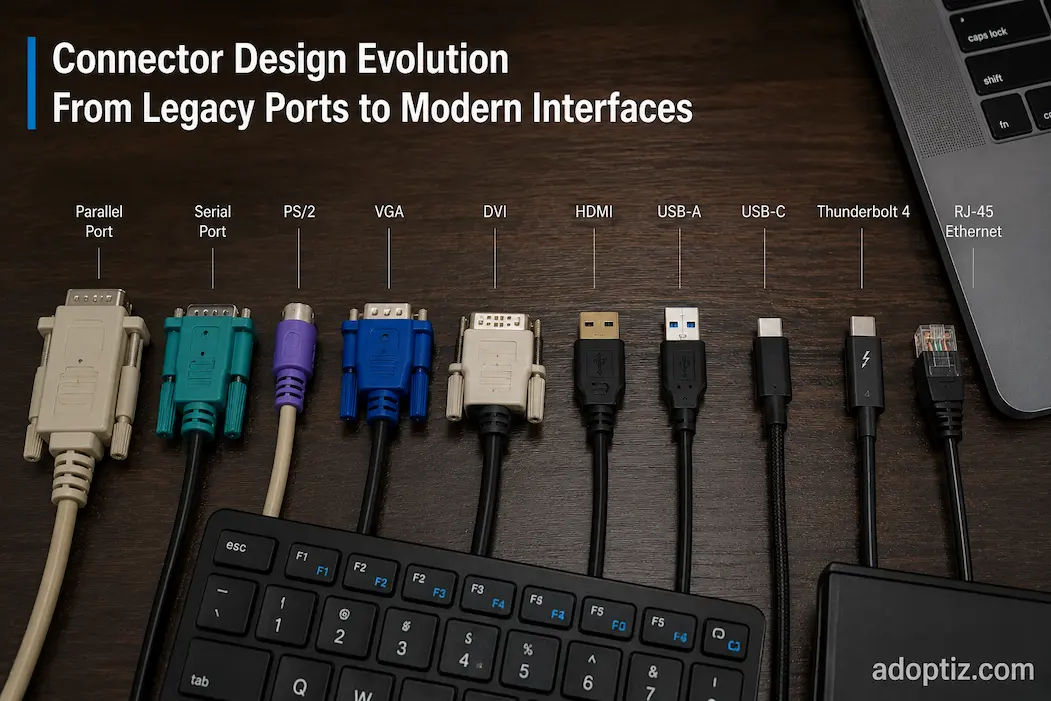
Connector Design Evolution From Legacy Ports to Modern Interfaces
Connectors are among the most overlooked components in modern computer systems. Users often focus on the speed of the CPU, memory, storage, and graphics card, yet the physical connections between devices determine how these components communicate, receive power, and exchange data. A connector is more than just a simple plug-and-socket combination; it is a technological solution designed to meet specific needs.
The shift from traditional ports to new interfaces reflects a broader transformation in computing itself. Because early systems were stationary, bandwidth was limited, and devices typically performed only a single function, computers relied on large, dedicated interfaces. As technology evolved, computers became smaller, faster, and more interconnected, creating a need for connectors capable of handling higher speeds while taking up less physical space.
Modern connectors, such as USB-C, represent a significant departure from earlier design approaches. Modern designs no longer dedicate separate ports to different functions; instead, they increasingly integrate multiple functions into a single interface that handles data, power, and display connectivity.
This shift is not driven solely by the greater convenience of the new design. It stems from fundamental technical considerations such as signal integrity, physical constraints, manufacturing complexity, and evolving user expectations.
Why Legacy Connectors Eventually Reached Their Limits
Early computer connectors were designed around the requirements of their time. A keyboard, mouse, printer, monitor, or storage device typically had a dedicated connection because each peripheral type used different communication methods and had relatively limited demands.
This approach worked well when computers were larger and users expected a collection of specialized ports.
However, as computing environments changed, these dedicated connectors began creating limitations. More devices meant more ports, more cable types, and more complexity for both manufacturers and users.
Legacy connectors often faced several challenges:
- Larger physical designs consumed valuable space.
- Separate standards increased manufacturing complexity.
- Limited bandwidth restricted newer devices.
- Older interfaces were not designed for modern power requirements.
The issue was not that older connectors were poorly designed. They were effective solutions for the problems engineers faced at the time. The challenge was that computing continued evolving beyond the conditions those connectors were created for.
The Relationship Between Connector Size and Device Design
One of the strongest forces behind connector evolution has been the demand for smaller and more portable devices.
Desktop computers historically had enough physical space for large connectors, expansion cards, and multiple dedicated ports. Portable computers introduced a different challenge. Every millimeter of internal space became valuable because manufacturers wanted thinner systems with larger batteries, improved cooling, and reduced weight.
Large legacy connectors became difficult to justify in compact designs.
This created pressure for smaller connection standards that could maintain or improve functionality while requiring less physical space.
The transition from larger connectors to smaller alternatives was not simply a cosmetic change. Reducing connector size required engineers to solve difficult problems related to:
- Contact durability.
- Manufacturing precision.
- Heat management.
- Signal reliability.
- Mechanical strength.
A smaller connector must still survive repeated use while maintaining reliable electrical contact.
Increasing Data Speeds Changed Connector Requirements
The growth of computing performance placed new demands on physical connections. Earlier connectors were designed when transferring small amounts of data was sufficient. Modern systems, however, move large volumes of information between storage devices, processors, displays, and external hardware.
Higher transfer speeds create new engineering challenges.
A connector must maintain accurate signal transmission while dealing with faster electrical changes. At higher speeds, issues that were insignificant in older systems become important, including electromagnetic interference, signal loss, and timing accuracy.
The physical design of the connector, the materials used, and the arrangement of electrical contacts all influence performance.
This phenomenon is why connector evolution often occurs alongside improvements in communication standards. A faster protocol requires a physical connection that can support that increased capability.
From Single-Purpose Ports to Multifunction Interfaces
One of the most significant changes in connector design has been the move away from specialized ports toward multifunction interfaces.
Older systems commonly used separate connectors for different tasks:
- One port for display output.
- Another for data transfer.
- Another for charging.
- Another for networking.
This approach provided clear separation but increased complexity.
Modern interfaces aim to combine multiple functions through a single connection. A single port may now support data transfer, external displays, and power delivery depending on the implementation.
This design philosophy offers several advantages:
- Fewer physical ports are required.
- Devices can become thinner.
- Users need fewer cables.
- Manufacturers can simplify product designs.
However, multifunction designs also introduce new challenges. A connector that supports many capabilities requires more complex hardware, clearer standards, and better communication between devices.
The simplicity users experience externally often requires significant engineering complexity internally.
The Engineering Trade-Off Behind Smaller Connectors
Reducing connector size creates a constant balancing challenge. Engineers want connectors to be smaller, but they must also remain reliable throughout years of usage.
A connector used daily may experience thousands of insertion and removal cycles. Each connection must maintain proper alignment and electrical contact despite physical wear.
Smaller designs introduce additional difficulties because there is less room for mechanical reinforcement and electrical separation.
A successful connector design must balance:
| Design Requirement | Engineering Challenge |
|---|---|
| Smaller size | Maintaining durability and signal quality |
| Higher speed | Preventing transmission errors |
| More functions | Managing increased technical complexity |
| Lower manufacturing cost | Maintaining reliability |
This balance explains why connector improvements often require extensive testing. A connector is not successful simply because it is smaller or faster; it must remain dependable in real-world conditions.
Why Connector Standards Take Time to Replace Older Designs
Even with significant benefits, changing existing standards is no simple task. Connectors are widely used across a broad ecosystem that includes computers, accessories, cables, industrial equipment, and consumer products.
A new design must gain widespread acceptance to fully replace an older standard.
This leads to a transition period during which multiple generations of connectors often coexist. Users may encounter adapters, converters, and hybrid solutions designed to link new and old technologies.
Compatibility becomes a crucial consideration, as businesses and consumers rarely upgrade all their devices at once.
Therefore, a connector’s lifespan depends not only on its technological capabilities but also on the scale of the ecosystem in which it operates.
The Transition from Modern Interfaces to Unified Connectivity
The evolution of modern connectivity represents a major shift in how computer systems are designed. Early connectors often employed diverse connection methods because each device type had its own specific requirements. Monitors required one type of connection, printers another, and external storage devices used yet other communication methods. Modern systems are rapidly evolving toward unified connectivity, allowing a single interface to be compatible with multiple types of devices. This approach reduces physical complexity and enables manufacturers to produce thinner, lighter, and more flexible products.
However, achieving this level of adaptability requires advanced engineering. Multifunctional connectivity must be capable of handling multiple signals, assessing available functions, and ensuring reliable communication between devices with varying needs.
The convenience experienced by consumers is the result of complex coordination between hardware and software. Devices must be able to recognize each other, determine the supported functions, and adapt their communication accordingly.
Why Physical Connector Design Still Matters in a Digital Era
It may seem that as wireless technology improves, physical connectors would become less important. However, wired connections continue to provide advantages that wireless systems often cannot match.
A physical connector can offer:
- Higher sustained data transfer capability.
- Lower latency.
- More reliable connections.
- Efficient power delivery.
- Reduced interference.
For demanding applications, such as professional displays, high-speed storage, and specialized equipment, a physical connection remains essential.
This is why connector design continues to evolve rather than disappear. The challenge is not eliminating cables entirely, but creating connection systems that provide greater capability while reducing inconvenience.
Modern connector development focuses on improving the relationship between physical hardware and digital communication.
The Challenge of Maintaining Backward Compatibility
Connector evolution often creates tension between progress and compatibility. A completely new design may offer significant technical improvements, but replacing an established connector can disrupt existing users and industries.
Manufacturers must consider questions such as:
- How many existing devices depend on the older standard?
- Can adapters provide a practical transition?
- Will compatibility reduce the benefits of the new design?
- Is the older technology still adequate for many users?
Maintaining compatibility can extend the usefulness of older hardware, but it can also introduce limitations. Supporting previous designs may require additional components or prevent manufacturers from fully optimizing new systems.
This is a recurring challenge in technology development. Progress rarely happens through complete replacement; instead, it usually occurs through gradual transitions.
Connector Reliability and Long-Term Durability
A connector is one of the few parts of a computing system that users physically interact with regularly. Unlike internal components that remain protected inside a device, connectors experience repeated mechanical stress.
Every insertion and removal cycle places pressure on:
- Contact points.
- Housing materials.
- Alignment mechanisms.
- Internal connections.
A well-designed connector must maintain performance despite this repeated usage.
Durability becomes especially important in portable devices, where connectors are exposed to frequent movement, environmental changes, and accidental stress.
This highlights an important aspect of connector engineering: performance specifications alone do not determine quality. A connector must also survive real-world usage over the expected lifetime of the device.
The Hidden Complexity of Standardization
Creating a successful connector standard involves more than designing a physical shape. The entire ecosystem surrounding the connector must be considered.
A complete standard includes elements such as:
- Electrical specifications.
- Communication protocols.
- Power requirements.
- Testing procedures.
- Compatibility guidelines.
Without clear standards, different manufacturers may implement the same connector differently, creating confusion and unreliable user experiences.
This is one reason some connectors become widely adopted while others disappear. Technical capability matters, but successful adoption also depends on consistency across manufacturers and products.
A connector becomes valuable when users can trust that compatible devices will work together.
Why Connector Evolution Will Continue
The history of connector development shows that physical interfaces change whenever technology creates new requirements. The next generation of computing will likely continue introducing challenges that existing connectors cannot fully address.
Future connector designs may need to support:
- Higher data volumes.
- Increased power requirements.
- Advanced display technologies.
- New computing architectures.
- Greater device integration.
However, future development will not only focus on faster speeds. Practical usability will remain equally important.
Users expect connections to be simple, reliable, and flexible. The most successful designs will likely be those that combine technical capability with ease of use.
Understanding the Engineering Process Behind Connector Evolution
From a user’s perspective, connector upgrades are commonplace: old ports are replaced by new ones. However, the engineering processes driving these changes are far more complex.
Each generation of connectors represents a specific problem that engineers sought to solve at the time.
Older ports emphasized compatibility with the devices of their era. Newer interfaces prioritized higher speeds, smaller form factors, improved power delivery, and greater versatility.
Neither strategy is inherently superior. A successful connector meets the needs of the surrounding technologies.
The transition from traditional ports to modern interfaces reflects a common phenomenon in the computing industry: as systems become more powerful and compact, connectivity must evolve in tandem.
Connectors may seem simple, but they provide the physical foundation that enables communication between different generations of technology.
Conclusion
The shift from traditional connectors to modern interfaces involves far more than simply swapping old plugs for smaller ones. It is the result of ongoing engineering decisions shaped by constantly changing performance requirements, device designs, and user expectations.
While older connectors served their intended purposes well, the growing demand for speed, mobility, and versatility has driven the development of new solutions. Modern interfaces are designed to simplify connections while supporting increasingly complex systems.
The future of connector design lies in striking a balance between competing needs—such as speed versus reliability, compactness versus durability, and innovation versus compatibility.
A successful connector is more than just the smallest or fastest option. It is a carefully designed bridge that connects various technologies and ensures that components can communicate consistently with one another as computer technologies evolve.