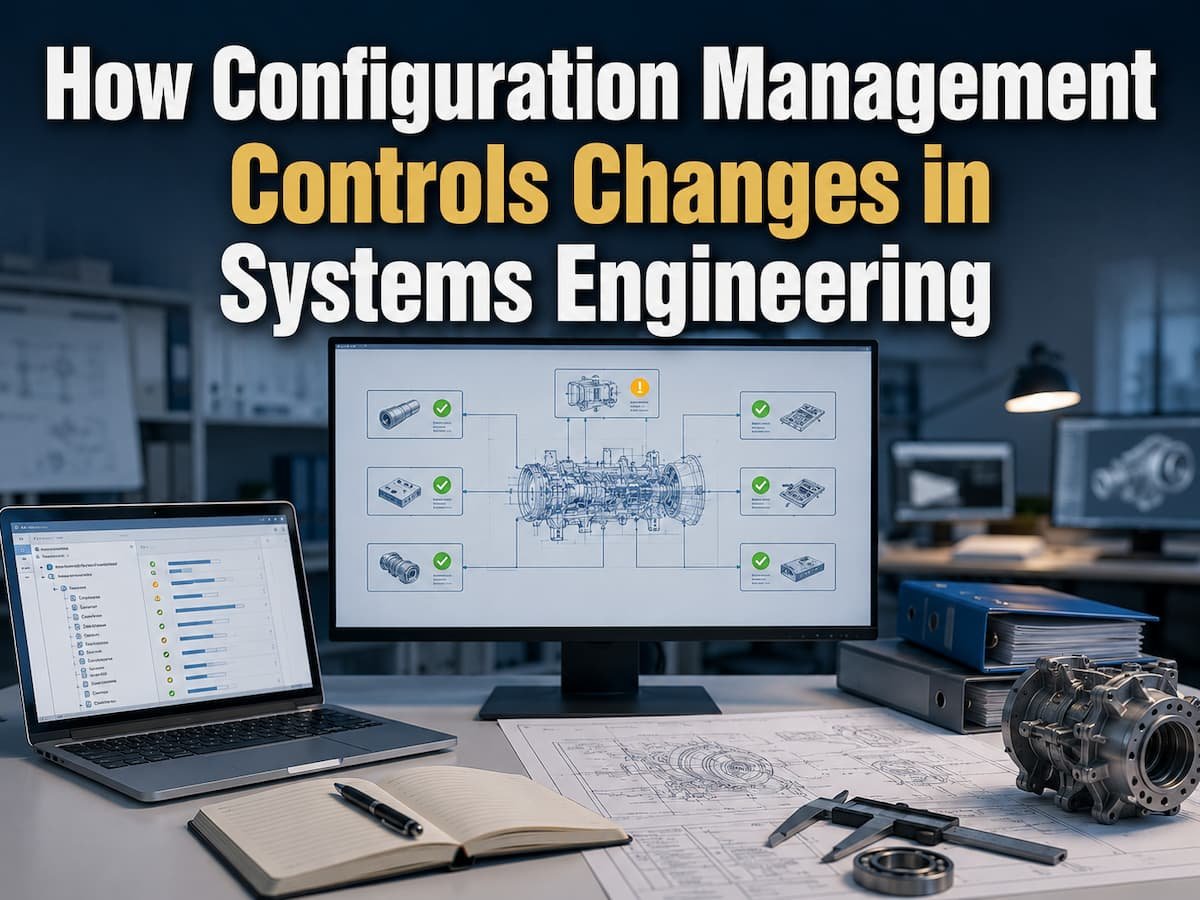
How Configuration Management Controls Changes in Systems Engineering
A change to an engineered system rarely affects just one thing. Altering a software component can change an interface. Replacing a hardware component can affect testing, documentation, procurement, maintenance, or performance requirements. Even a seemingly minor modification can create confusion when different people are working from different versions of the system definition.
Configuration management provides a structured way to control that situation. In systems engineering, it establishes what constitutes the system, identifies approved versions and baselines, records changes, and helps ensure that the people implementing, testing, documenting, and operating the system are working with consistent information.
This approach does not mean configuration management prevents change. Engineering programs need change throughout development and operation. Instead, configuration management makes change visible and controlled. A proposed modification can be evaluated, approved, implemented, verified, and recorded without losing the relationship between the original configuration and the updated one. The result is a more traceable engineering process in which teams can answer practical questions such as what changed, why it changed, who approved it, which version contains the change, and whether the resulting configuration was verified.
Configuration Management Starts by Defining What Is Being Controlled
Before an organization can control changes, it needs to know what belongs to the configuration being managed. A system may contain physical components, software, requirements, interface definitions, drawings, specifications, test procedures, models, source code, manufacturing information, and other technical records. Configuration management identifies the items that need controlled treatment rather than allowing every file or object to be handled independently.
These controlled elements are commonly referred to as configuration items.
For example, imagine an engineering team developing an industrial control system. The controller hardware, embedded software, interface specification, wiring documentation, and system-level requirements may all be configuration items or may contain information associated with configuration items.
The exact boundaries depend on the project. A small engineering project may have a relatively simple configuration structure, while a large aerospace, automotive, defense, medical, or industrial program can contain thousands of interconnected items. The important principle is to establish an identifiable configuration that you can describe and manage consistently.
Baselines Create a Known Point of Reference
One of the most useful concepts in configuration management is the baseline. A baseline represents an approved configuration or set of configuration information that provides a stable reference for further work. Once established, proposed changes can be compared against that reference instead of relying on whichever version happens to be on someone’s computer.
Consider a software-and-hardware system that has completed an agreed-upon design review. The organization may establish a baseline containing the approved requirements, design information, software version, interface definitions, and other relevant artifacts.
A later change can then be described in relation to that baseline. This makes conversations much clearer. Rather than saying, “We changed the controller last week,” an engineering team can identify the affected configuration item, the approved change, the resulting version, and the verification evidence associated with it. Baselines therefore provide stability without implying that the system can never change.
Change Control Adds a Decision Process Around Modifications
Configuration control becomes especially important when someone proposes a change. A disciplined process generally begins with a documented change request or equivalent record. The proposed modification is then evaluated for its technical and programmatic effects before approval.
The depth of that evaluation depends on the system and the change. A small documentation correction may require very little analysis. A change to a major interface or safety-critical component can require substantially more investigation.
A useful change-control process considers questions such as the following:
- What is being changed?
- Why is the change necessary?
- Which requirements, interfaces, components, or documents are affected?
- What other systems could be affected?
- What testing or verification is required?
- Which baseline or version will change?
- Who has authority to approve the modification?
- How will the completed change be recorded?
The purpose is not bureaucracy for its own sake. The purpose is to prevent an apparently local modification from creating an unrecognized system-level consequence.
Impact Analysis Connects a Change to the Rest of the System
Systems engineering is concerned with relationships between parts, which makes impact analysis central to configuration control.
Suppose an engineering team replaces a communication module because the original component is no longer available. The replacement might appear equivalent at the component level, but it could have different electrical characteristics, software dependencies, timing behavior, physical dimensions, or interface requirements.
A change assessment therefore needs to consider the component being replaced. Requirements may need review. Interfaces may need testing. Manufacturing instructions may need updating. Procurement information may change. Maintenance documentation may require revision. This scenario is where traceability becomes valuable. When configuration information is linked to requirements, interfaces, tests, and documentation, engineers have a better basis for identifying what could be affected by a proposed change. Without those relationships, impact analysis can depend heavily on individual memory.
Configuration Status Accounting Keeps the Change History Visible
Approving a change is not enough. An organization also needs to know what happened to it. Configuration status accounting provides information about the state and history of configuration items and changes. The specific implementation varies between organizations, but the underlying purpose is maintaining an understandable record. For a particular configuration item, useful information might include its identifier, current revision, previous revision, approved changes, implementation status, and verification status.
This becomes particularly important when several changes are moving through an engineering program simultaneously. Imagine that three teams are modifying different aspects of a system. One change has been approved but not implemented. Another has been implemented and is undergoing testing. A third has completed verification and is part of the released configuration.
Without reliable status information, someone may accidentally assume that all three changes are already incorporated. A controlled status record helps distinguish proposed, approved, implemented, verified, and released configurations.
Version Identification Prevents Teams From Working on Different Configurations
Configuration management also solves a deceptively simple problem: identifying which version people are actually using. In software development, version-control systems can record revisions to source code and related artifacts. In hardware engineering, revision identifiers, part numbers, drawings, and controlled documentation can serve similar purposes.
The principle is the same: the identity of a configuration should be unambiguous. Imagine a test engineer reporting that a problem occurs on “the latest version.” That description is weak if several builds or hardware revisions exist.
A controlled configuration might instead identify a specific software build, hardware revision, interface specification, and test baseline. That level of identification allows another engineer to reproduce the configuration rather than trying to reconstruct it from informal descriptions.
Verification Determines Whether the Approved Change Actually Worked
A change is not complete simply because someone installed it. The organization needs to determine whether the resulting system satisfies the applicable requirements and performs as intended. The verification activity depends on the nature of the modification. A documentation-only change may require document review. A software modification may require appropriate testing. A hardware redesign could require inspection, analysis, testing, or other forms of verification.
The critical connection is between the approved change and the evidence demonstrating that the resulting configuration is acceptable. For example, if a change modifies an interface, verification should address the relevant interface behavior rather than simply confirming that the new component was installed. This prevents configuration control from becoming a paperwork exercise. The objective is not merely to record that a change occurred but to establish what configuration now exists and whether it has been adequately verified.
Configuration Audits Check Whether Records Match Reality
Configuration audits provide another layer of control by examining whether the documented configuration corresponds with the actual or intended system.
Two related questions are particularly useful.
- Is the configuration technically correct? This concerns whether the system satisfies its approved requirements and technical definition.
- Is the configuration correctly documented? This concerns whether the records accurately identify the components, versions, changes, and supporting information that make up the configuration.
An organization can have technically competent engineering work but poor configuration records. It can also have perfectly organized records that describe a system that has not been adequately verified. Auditing helps identify these discrepancies. The exact terminology and audit practices vary by industry and standard, but configuration audits are commonly associated with checking the integrity and consistency of the controlled configuration.
Configuration Management Links Engineering Work Across the Lifecycle
Configuration management extends beyond the design phase. During development, it helps control evolving requirements, designs, models, software, hardware, and test configurations. During production, it can help ensure that manufacturing uses the intended design information. During deployment and operation, it also supports controlled modifications and maintenance records. During retirement, it can help preserve information about the final configuration and any changes made throughout service.
This lifecycle perspective matters because system changes do not stop when development ends. An operational system may receive software updates, component replacements, interface modifications, security patches, or maintenance changes. Each modification can create relationships with existing configuration information. If those relationships are not maintained, the organization gradually loses its ability to describe exactly what is deployed. Configuration management therefore acts as a continuity mechanism between engineering stages.
Configuration Management and Change Management Are Related but Not Identical
The terms “configuration management” and “change management” are sometimes used interchangeably, but they describe different areas of concern. Change management focuses on how people propose, evaluate, approve, implement, and adopt changes. Configuration management provides control over the identity, state, relationships, and history of the configuration being changed.
In systems engineering, the two activities work together. A change process might determine that a modification is approved. Configuration management then helps establish which configuration items are affected, which versions result from the implementation, and how the updated configuration is recorded. This distinction becomes especially useful in complex programs where organizational, technical, contractual, and operational changes may occur at the same time.
Automation Helps, but Tools Do Not Replace Configuration Discipline
Modern engineering organizations often use specialized tools to manage requirements, source code, models, documents, hardware information, test results, and change records. These tools can make configuration management much more efficient. Automated version histories, access controls, approval workflows, relationships between artifacts, and status dashboards can reduce manual effort and improve visibility.
But a tool cannot decide whether an item should be controlled, whether a change has been adequately analyzed, or whether the right people approved a modification. Poor configuration practices can simply become automated poor configuration practices. The underlying process still needs clear ownership, identification rules, approval authority, version conventions, and verification expectations.
What Happens When Configuration Control Is Weak?
The consequences often appear gradually rather than as one dramatic failure. One engineer may use an outdated specification. A test team may validate a different software build from the one used by integration. A drawing may not match the hardware revision being manufactured. A maintenance team may install a component based on obsolete documentation.
Each discrepancy can seem small in isolation. Together, they make the system increasingly difficult to understand. Troubleshooting becomes slower because engineers first have to determine which configuration actually exists. Testing may need to be repeated because the tested configuration cannot be reproduced. Teams may waste time resolving differences that identification and status tracking should have prevented.
Configuration management reduces these problems by maintaining a controlled relationship between the system and the information used to define, build, test, operate, and modify it.
A Practical Change-Control Example
Consider an engineering team that wants to replace a processor in an embedded system because the original processor has become difficult to source. The proposed change begins as a documented request. Engineers identify the affected processor configuration item and examine related requirements, interfaces, software dependencies, power requirements, thermal considerations, manufacturing information, and test procedures.
The change is reviewed and either approved, rejected, or returned for additional analysis. If approved, the relevant design artifacts are revised and assigned new identifiers or revisions according to the organization’s configuration rules. The replacement processor is integrated and subjected to the required verification activities.
Once the evidence is accepted, the updated configuration becomes part of the appropriate controlled baseline or released configuration. At every stage, the organization can answer the basic questions: what changed, why it changed, what was affected, who authorized it, what version resulted, and how the change was verified. That is configuration control in practical terms.
The Real Value Is Traceability
Configuration management is sometimes viewed primarily as document control, but its deeper value is traceability. A well-managed engineering configuration enables teams to follow relationships across requirements, designs, components, interfaces, software, tests, approvals, and releases.
When a requirement changes, engineers can investigate the related design elements. When a component changes, they can identify associated interfaces and verification activities. When a test fails, they can determine which configuration produced the result.
This creates a more dependable engineering information chain. The objective is not to eliminate change. Change is an unavoidable part of systems engineering. The objective is to make change understandable, authorized, reproducible, and technically accountable.
Conclusion
Configuration management controls change by establishing a clear identity for system elements, creating known baselines, recording proposed and approved modifications, analyzing their effects, tracking implementation status, and connecting changes to verification evidence.
Its value becomes most apparent when systems grow complex. Hardware, software, requirements, interfaces, documentation, and test activities can evolve at different speeds, and without a controlled configuration, teams can easily lose track of which version is authoritative. A strong configuration-management process provides engineering teams a reliable reference point while still allowing the system to evolve. It turns change from an informal modification into a traceable engineering activity.
For organizations managing complex systems, that traceability is more than administrative convenience. It provides the information needed to understand what the system is, how it has changed, and whether the current configuration matches the configuration that was actually approved and verified.
FAQs
1. What is configuration management in systems engineering?
Configuration management is the discipline used to identify, document, control, track, and verify the configuration of a system throughout its lifecycle. It helps ensure that engineering teams know which versions and changes are authorized and current.
2. What is a configuration baseline?
A configuration baseline is an approved reference configuration against which subsequent changes can be evaluated and controlled. It provides a known point of reference for engineering work.
3. How does configuration management control engineering changes?
It establishes a process for identifying proposed changes, assessing their effects, obtaining appropriate approval, implementing the modification, verifying the result, and updating the controlled configuration records.
4. Why is configuration control important in systems engineering?
Systems contain interconnected hardware, software, requirements, interfaces, documentation, and tests. A change to one element can affect others. Configuration control helps teams identify those relationships and maintain consistency between the actual system and its technical definition.
5. What is configuration status accounting?
Configuration status accounting is the process of maintaining information about the identity, status, revisions, and history of configuration items and changes. It helps teams determine which changes have been proposed, approved, implemented, verified, or released.
6. What is the difference between configuration management and change management?
Change management focuses primarily on managing the change process, while configuration management focuses on maintaining the identity, status, relationships, and integrity of the configuration being changed. They are complementary activities.
7. Can configuration management be automated?
Software can support many configuration-management activities, including version control, approval workflows, status tracking, traceability, and audit records. However, tools do not replace engineering judgment or clearly defined configuration-control processes.
8. What happens when configuration management is poorly controlled?
Teams can end up working from different versions of requirements, designs, software, hardware, or documentation. This can make testing, troubleshooting, maintenance, and system reproduction more difficult, and it can increase the risk of unintended changes.