USB Power Delivery and the Science Behind Smart Charging
Nowadays, chargers are more than just devices that supply power. Connecting a cable to draw power has evolved into a complex “dialogue” between the charger, the cable, and the device. Smartphones, laptops, tablets, and other connected devices do not simply accept power from the charger; they communicate with it to determine how much power can be transferred safely and efficiently between them.
This shift was inevitable as portable electronics became increasingly powerful. Early USB interfaces were primarily used for data transfer and charging low-power devices. Today, however, new devices require significantly more power. Laptops now use USB ports for charging, smartphones require faster charging speeds to support their larger battery capacities, and an increasing number of devices rely on a single universal connector.
USB Power Delivery (USB PD) technology marks a significant step from simple charging to intelligent power management. It enables devices to communicate with one another, understand each other’s needs, adjust charging methods in real time, and strike the optimal balance between speed and safety. Electrical engineering, communication protocols, thermal management, and battery protection systems work together to make this possible.
Therefore, simply knowing a charger’s wattage is insufficient to understand USB PD. It is about understanding how modern electronic devices determine when, how, and why they transfer power.
USB Power Delivery Changed the Meaning of Charging Compatibility
Before the widespread adoption of USB PD, charging was typically limited to a fixed power level. The charger delivered a specific amount of power to the connected device, and the device attempted to operate within those limits. This approach worked for small devices, but as devices became more complex, it became harder to use.
Although laptops and wireless headphone cases both use USB interfaces, their power requirements differ vastly. A universal charging system needed a way for devices to communicate and recognize these differences, rather than relying on guesswork.
USB PD offers a more adaptive model. It allows chargers and devices to exchange information before large amounts of power are transferred, ensuring that not every connection is treated in the same way.
The device can communicate:
- How much power it needs.
- Which voltage levels it supports.
- Whether additional power is required during operation.
- When charging should slow down.
The charger can then respond according to those requirements rather than continuously providing maximum output.
This communication process is one of the biggest reasons modern charging systems are safer and more efficient than older approaches.
Smart Charging Begins With Negotiation, Not Maximum Output
One of the most common misunderstandings about fast charging is the assumption that a powerful charger constantly pushes its maximum rated power into any connected device.
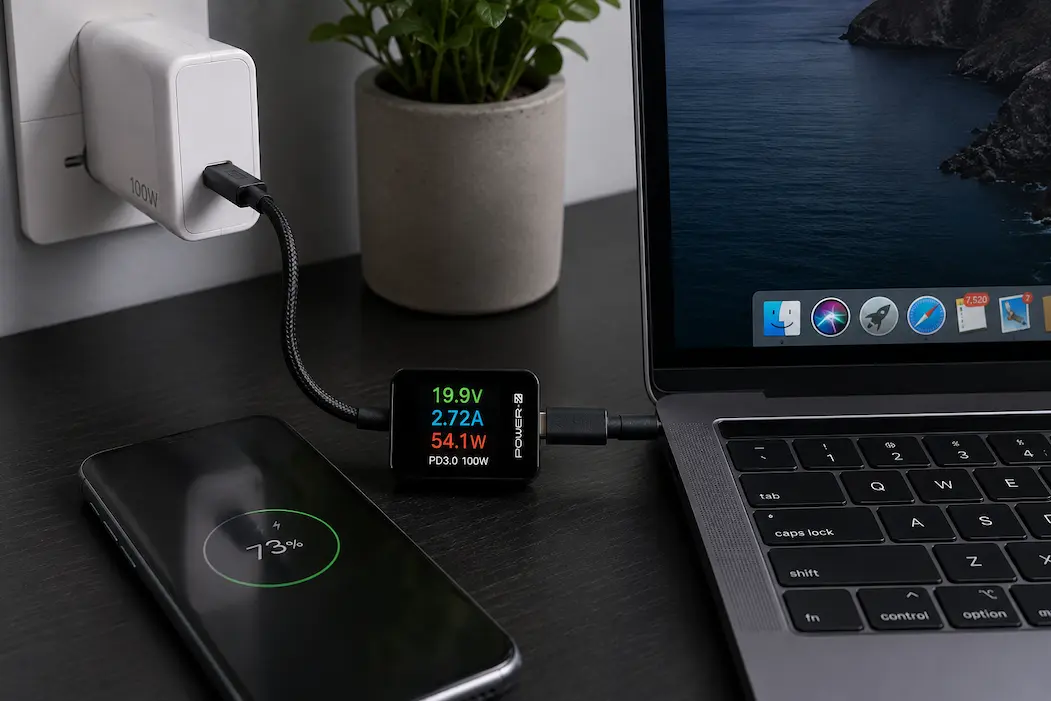
In reality, charging is a controlled negotiation. A 100-watt USB PD charger does not force 100 watts into every device connected to it. Instead, the connected device determines what it can safely accept, and the charger provides power within those limits.
This relationship works because both sides understand predefined power profiles. The charger advertises its available capabilities, and the device requests an appropriate operating level.
For example, a laptop may request higher power because it needs energy for both charging the battery and running demanding workloads. A smartphone may request a lower level because its battery design and thermal limits are different.
This approach prevents several problems:
- Delivering more power than a device can handle.
- Creating unnecessary heat.
- Reducing battery lifespan.
- Wasting energy through inefficient conversion.
Smart charging is therefore not about making electricity move faster at all times. It is about making power delivery more intelligent.
The Engineering Relationship Between Voltage, Current, and Power
At the physical level, charging performance depends on the relationship between voltage, current, and power. Increasing either voltage or current can increase available power, but each approach introduces different engineering challenges.
Higher current requires conductors capable of carrying more electrical flow without excessive heat generation. Higher voltage can improve efficiency in certain situations but requires careful insulation, regulation, and component design.
USB PD allows devices to use different voltage and current combinations rather than relying on a single fixed approach.

(Note: The relationship between electrical power and voltage/current is conceptually similar to how engineering systems balance different variables, although USB PD specifically depends on electrical power management rather than fluid pressure principles.)
Modern charging systems manage these variables continuously to deliver useful power while keeping temperatures and electrical stress within acceptable limits.
The challenge is not simply delivering more energy. The challenge is delivering more energy without creating conditions that reduce reliability.
Why More Charging Power Creates New Engineering Problems
Increasing charging speed appears simple from the user’s perspective: more power means less waiting. However, higher power levels introduce several technical challenges that engineers must solve.
Heat Management Becomes a Major Factor
Electrical energy is never transferred with perfect efficiency. Some energy is lost as heat during power conversion, cable resistance, and battery charging processes.
As charging power increases, managing this heat becomes increasingly important. Excessive heat can affect:
- Battery aging.
- Charging efficiency.
- Component reliability.
- User comfort.
This is why many devices reduce charging speed when temperatures rise. The slower charging behavior is not necessarily a limitation—it is a protective response designed to maintain reliability.
The Cable Becomes Part of the System
A common assumption is that the charger determines charging capability alone. In reality, the cable is also an important component.
A cable must support the required electrical characteristics to safely carry higher power levels. Poor-quality or unsuitable cables may limit charging performance or prevent higher-power modes from activating.
Modern USB PD systems therefore treat the charger, cable, and device as a complete charging system rather than independent parts.
Why Devices Slow Down Charging at Different Stages
Many users notice that a device charges quickly when the battery level is low but slows down significantly as it approaches full capacity. This behavior is intentional and reflects battery management principles.
Lithium-ion batteries are sensitive to charging conditions, especially near maximum capacity. Delivering high power continuously until the battery reaches 100% would increase heat and stress, potentially reducing long-term battery performance.
Instead, charging systems typically adjust their behavior throughout the charging cycle.
Early charging often prioritizes speed because the battery can accept energy more efficiently. As the battery approaches a higher state of charge, the system gradually reduces power to protect battery health.
This demonstrates an important principle of smart charging:
The fastest charging method is not always the one that delivers the highest power for the longest time.
A well-designed charging system balances speed, efficiency, temperature, and long-term reliability.
Power Profiles and Why Chargers Behave Differently With Each Device
One of the strengths of USB Power Delivery is its ability to support a wide range of devices without requiring every charger to be designed for only one product category. A single charger can potentially support a smartphone, tablet, handheld console, or laptop because the charging process adapts according to the capabilities of the connected device.
This flexibility comes from predefined power profiles and communication rules. Instead of a charger having one fixed output, it can support multiple operating levels. The connected device selects the most appropriate option based on its own power requirements and limitations.
This approach creates a more efficient ecosystem because users do not need a separate charger for every device. However, it also means that the final charging speed depends on the relationship between all parts of the system.
A high-capacity charger connected to a low-power device will not automatically produce faster charging. Similarly, a powerful device connected to a weaker charger may operate normally but charge slowly or limit performance during demanding tasks.
The actual result depends on the interaction between:
- The charger’s supported power levels.
- The cable’s electrical capability.
- The device’s charging hardware.
- Battery condition and temperature.
- Current workload.
The Role of Power Management in Modern Technology
USB power delivery does not operate in isolation. An internal power management system within the device determines how power is distributed. This section describes how these systems work together.
For instance, a laptop does not direct all the power it receives to the battery. Some of the power is used immediately to run the processor, screen, storage, and other components, while the remainder is used to charge the battery.
This means that the same charger can yield different charging results depending on the device’s usage status.
A laptop running multiple programs may consume the majority of the incoming power for its operations, leaving less power available to charge the battery. If the laptop sits idle for a while, it can charge faster because more power can be directed to the battery.
Therefore, charger specifications are not the only factor determining charging speed. The device itself constantly manages its priorities and adjusts power consumption accordingly.
Efficiency Matters More Than Maximum Power
People often assume that higher power output means faster charging, as the focus is usually on charging speed. However, efficiency is often just as important as maximum power.
Energy is lost at every stage of the conversion process. A charger draws power from a wall outlet and converts it into a form the device can use. Internal electronics regulate the power allocated to various components. During these steps, some energy is converted into heat.
A well-designed charging system minimizes this energy loss while ensuring the system temperature remains within safe limits.
That is why two chargers with the same rated power output can perform differently. Actual performance is influenced by factors such as component quality, conversion efficiency, cooling design, and power management methods.
A charger with slightly lower peak power but stable, reliable operation may outperform one that prioritizes maximum output but suffers from inadequate thermal management.
Compatibility Is More Complex Than Having the Same Connector
The advent of USB-C has made physical connectivity more accessible worldwide, but this does not mean that all devices function identically.
Two devices might connect to the same USB-C port, yet their charging methods can differ drastically. One device might support advanced USB Power Delivery protocols, while another supports only basic charging methods.
This distinction is crucial, as variations in connectivity can lead to unrealistic expectations. Users often assume that any USB-C charger or cable will work, but in reality, compatibility depends on the connection’s underlying technology.
A complete charging system requires agreement between:
- The charger.
- The cable.
- The device.
- The charging controller inside the device.
If any part of this chain has limitations, the final charging behavior will adjust accordingly.
Smart Charging Is Also About Protecting Hardware
Fast charging technology is sometimes viewed as a competition to deliver the highest possible power, but reliability remains a central engineering concern.
The battery is one of the most sensitive components in a portable device. Heat, charging speed, and repeated stress all influence how quickly battery capacity changes over time.
Modern charging systems therefore include protective strategies such as:
- Reducing charging speed at higher temperatures.
- Adjusting power delivery based on battery condition.
- Preventing unsafe electrical conditions.
- Monitoring charging cycles.
These systems represent a balance between user expectations and hardware preservation. A device that charges slightly slower but maintains better long-term battery health may provide greater value than one optimized only for short-term speed.
The Future of USB Power Delivery
As devices continue becoming more powerful, the role of intelligent power management will become increasingly important. Portable computers are approaching performance levels that once required desktop systems, while users expect charging solutions that remain simple and universal.
Future improvements will likely focus not only on increasing available power but also on improving efficiency, reducing heat, and making communication between devices more intelligent.
The challenge will not simply be delivering more electricity. It will be managing energy in a way that supports higher-performance devices without sacrificing reliability or convenience.
USB Power Delivery represents an important shift in how electronics handle power. Instead of treating charging as a basic transfer of electricity, it treats it as a coordinated interaction between multiple systems.
Choosing Charging Equipment With a Better Understanding
For most users, selecting charging equipment does not require understanding every technical detail. However, recognizing a few important principles can prevent common mistakes.
A suitable charging setup should consider:
- The actual power requirements of the device.
- Whether the cable supports the required charging level.
- Whether the charger follows widely supported standards.
- Whether the device benefits from higher charging speeds.
The highest-rated charger is not always the best choice. A balanced combination of compatibility, efficiency, and reliability usually provides better long-term results.
A modern charging system works because every part cooperates—the charger provides available options, the device communicates its needs, the cable enables safe transfer, and internal electronics manage the final delivery.
That cooperation is the real science behind smart charging.
FAQs
1. Do high-power USB PD chargers damage small devices?
In most cases, no. The USB PD protocol is designed so that compatible devices automatically determine the appropriate charging power. Most devices do not automatically accept the charger’s full output power, but only the power level they were designed to handle.
2. Why is my device charging so slowly with a high-power charger?
Charging speed is influenced by many factors, such as the data cable’s current capacity, the device’s charging hardware, the battery’s temperature and charge level, and the device’s own power consumption while charging.
3. Is faster charging always better for the battery?
Not always. While faster charging is beneficial, monitoring battery temperature and charging conditions is crucial for extending battery life. Smart charging systems typically reduce charging power when the battery is under extra strain, thereby preventing a reduction in battery lifespan.