Stable Power Delivery and Its Influence on Long-Term System Reliability
People typically check their computers for software vulnerabilities, memory issues, or overheating problems—such as random restarts after hours of continuous rendering, occasional calculation errors under heavy load, or instability occurring only during demanding workloads. While these are certainly worth checking, the quality and stability of the power supply are often overlooked, even though they affect every component of the system.
Wattage is often the only metric people discuss when it comes to power supplies. A 750-watt unit is frequently considered “better” than a 550-watt model simply because the wattage is higher. In reality, however, wattage doesn’t tell the whole story. For modern computer hardware, power delivery characteristics are just as important as the available power output. Components such as processors, graphics cards, storage devices, and memory maintain their intended performance levels after months or even years of continuous use thanks to stable voltage, clean power regulation, and reliable energy management.
Temperature and component quality are not the only factors influencing long-term system reliability. The power supply supporting various workloads often determines how long high-performance hardware remains reliable after the initial excitement of a brand-new build has faded.
Reliability Begins Before the Processor Does
Ultimately, every instruction executed by the processor, every file written to storage, and every image rendered by the graphics card relies on a stable and controlled power supply to these components. The system’s power delivery begins to influence the computer’s efficiency even before software loads or the operating system starts scheduling tasks.
Modern computer power supplies do not deliver raw power directly to sensitive internal components. Instead, the power undergoes multiple regulation and conversion processes to ensure the voltage precisely meets the requirements of the processor, memory, storage devices, and expansion cards. These voltages must remain extremely stable, even when workloads surge from near-zero to full capacity in a matter of seconds.
These rapid changes occur continuously. Power consumption can spike suddenly when you open an application, compile software, launch a game, or export a video. The power delivery system must respond quickly and without drastic fluctuations; this response is essential for proper device operation. Conversely, failing to achieve this increases the risk of various issues or instability.
Why Power Stability Matters More Than Peak Capacity
Choosing a power supply based solely on maximum wattage is like selecting a cooling system based only on fan size. While sufficient capacity is important, the efficiency of that capacity depends on its stability.
Modern processors and graphics cards do not maintain constant power consumption for extended periods. Their power demands shift continuously due to workload variations, clock frequency adjustments, and energy management algorithms that adapt to available thermal headroom. Because these demands are constantly changing, the power delivery system is under immense pressure; it must maintain stable, clean voltage amidst all these fluctuations.
Imagine two computers with identical hardware configurations. One uses a powerful, voltage-stable power supply, while the other uses a less powerful unit operating at its limit. When computing tasks are light, both machines appear capable of handling the workload. However, as computing power increases, the differences become apparent. A more stable system remains stable, whereas a less stable system may experience voltage fluctuations, triggering protection mechanisms and leading to degraded performance or instability.
This illustrates an important concept: a system’s reliability depends not primarily on its instantaneous power, but on its ability to meet constantly changing demands over the long term.
Editorial Observation
During troubleshooting of systems used for long rendering sessions, I’ve occasionally seen computers pass every short stress test yet restart unexpectedly after an hour or more of continuous work. In several of those cases, replacing neither the processor nor the graphics card solved the issue. The instability disappeared only after improving the quality of the power delivery, reinforcing how electrical consistency often becomes visible only under prolonged workloads.
How Energy and Thermal Management Work Behind the Scenes
Power delivery and cooling are often viewed as separate matters, but in reality, they are inextricably linked. Every watt of power consumed by electronic components is converted into heat that must be dissipated from the system. As system temperatures rise, energy efficiency drops, the cooling system has to work harder, and energy management algorithms must strike a balance between performance and thermal constraints.
Because of this interdependence, a stable power supply can indirectly contribute to stable temperatures. Effective voltage regulation reduces unnecessary energy loss, allowing more energy to be used for productive computing tasks rather than being wasted as heat. While these improvements might seem insignificant in isolation, their importance becomes clear when hardware operates over extended periods.
Conversely, poor cooling conditions place additional strain on power delivery components. Voltage regulators on processors and graphics cards generate heat while managing power flow. If these temperatures remain high for prolonged periods, the components can fail. Consequently, system designers view electrical regulation, airflow, and cooling design as engineering challenges requiring coordinated action, rather than as independent elements.
Viewing these systems in isolation risks overlooking the close collaboration between them—a collaboration that is essential for smooth system operation. A computer capable of efficiently handling demanding tasks for years rarely relies on just a single outstanding component; in most cases, success stems from the effective alignment of electrical design and thermal management.
Reliability is Central to the Entire Platform
When people talk about power delivery, they usually think of the power supply unit—the most obvious component of the electrical circuit. In reality, however, the entire platform is crucial to the reliability of the power supply. How power reaches the hardware depends on many factors, including motherboard voltage regulation, how the processor manages power, the graphics card’s design, firmware, and even cable quality.
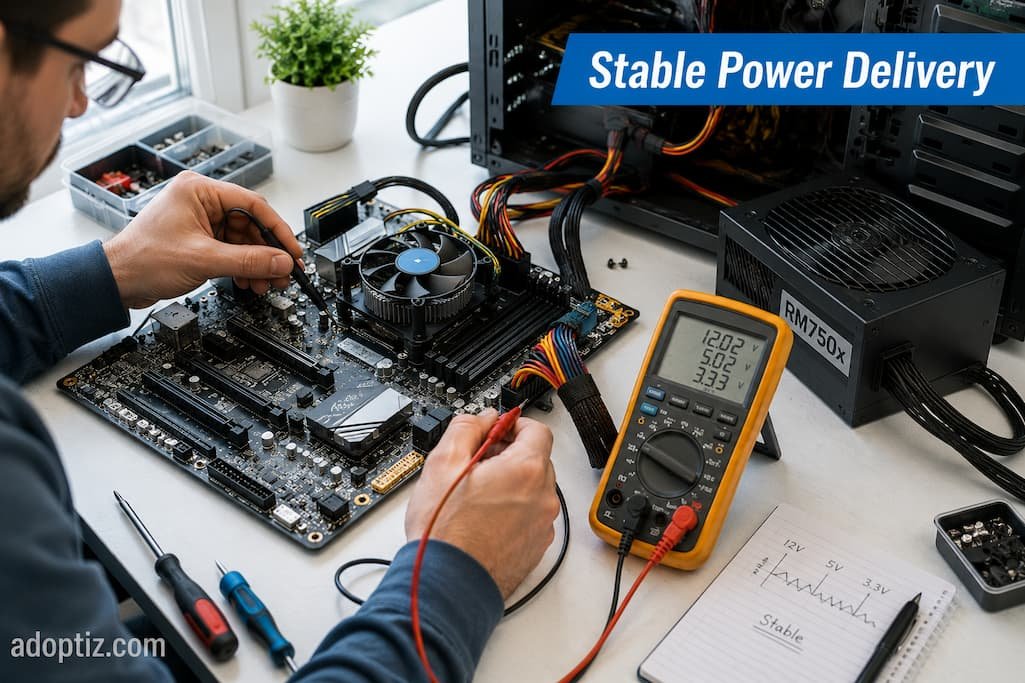
The voltage regulator module (VRM) on the motherboard is a prime example. Its role is to precisely regulate input voltage to the level required by the processor, even as the processor’s power consumption changes from millisecond to millisecond. A well-designed VRM does not necessarily increase processor speed, but it does help maintain stability during prolonged use without imposing excessive voltage stress.
The same principle applies to graphics cards, where onboard power circuits must rapidly adapt to changing processing loads. Power consumption is rarely constant during gaming or GPU-accelerated computing; instead, it fluctuates with changes in the scene, effects, and workload. Stable voltage regulation helps manage these changes effectively, allowing the hardware to operate predictably rather than constantly reacting to unstable power conditions.
When Power Issues Resemble Other Hardware Faults
Power issues are difficult to diagnose, partly because they do not always manifest in obvious ways. Power instability often does not appear as explicit error messages, but rather as distinctly different signs of trouble.
Workstations might only crash after prolonged rendering. Games might stop unexpectedly after an hour of play, even under ideal conditions. File corruption occurs infrequently, often leading to storage devices being the primary suspects. Furthermore, unexplained system restarts are frequently attributed to software updates or driver issues.
These symptoms can complicate troubleshooting, as each affected component appears to function correctly on its own. Patterns can sometimes only be identified by examining the system as a whole: instability often arises when multiple heavily loaded components operate simultaneously and their power demands fluctuate rapidly.
For this reason, experienced system technicians generally do not assess system reliability by inspecting individual components. Instead of focusing on seemingly faulty parts, they examine the entire power infrastructure to ensure it can consistently handle the full load.
Designing for Years Instead of Days
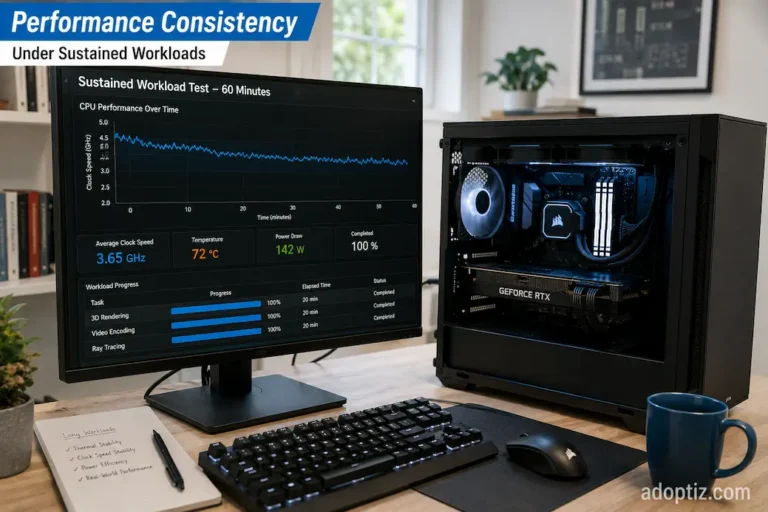
Reliability is often measured through long-term testing, not merely a few performance benchmarks. A system can only be considered truly functional under specific conditions if it passes all tests on the day of assembly. The more important question is whether it remains stable after thousands of hours of use, months of software updates, constantly changing workloads, and annual temperature fluctuations.
In a business environment, this perspective influences hardware selection. Workstations used for media production, engineering, education, or software development are often equipped with extra power headroom to avoid operating near their maximum capacity. This approach is not about wasting resources, but rather about reducing system load and ensuring that components function reliably over their expected lifespan.
The same logic applies to home systems designed for long-term use. Choosing hardware that operates within reasonable limits is generally better for long-term stability than chasing extreme speed. In many cases, stability is a better indicator of engineering quality than brief bursts of high output.
Looking Beyond the Wattage Rating
A stable power supply is often overlooked because it tends to go unnoticed when functioning correctly. Users focus on benchmark results, processor temperatures, and graphics performance, yet few give much thought to the power supply that supports these functions during daily use. However, any sustained workload relies on a proper, responsive, and reliable power supply from start to finish.
By viewing the power supply as an integral part of the system rather than just a single specification, one can make more informed choices when building, upgrading, or repairing computers. This shifts the focus toward overall design quality, rather than relying solely on rated power output or peak performance figures.
As the power demands of processors and graphics hardware continue to rise—and as their power usage patterns evolve—a stable power supply becomes increasingly critical. A computer’s reliability is not determined by a single aspect; it is the result of many well-designed systems working in concert, and a reliable power supply is one of the most crucial components among them.