Finding the Real Performance Bottleneck in Complex Computing Systems
When a computer runs slower than usual, people often think of the processor first. Noisy cooling fans, an outdated processor, or a heavily taxed CPU are common culprits. Yet, many systems with powerful processors still struggle with everyday tasks, while some systems with less powerful hardware maintain wonderful responsiveness even under heavy loads. Identifying the actual bottleneck is crucial.
A performance bottleneck is any component, resource, or process that slows down overall system performance. It is important to note that this limitation is rarely permanent; it varies depending on the workload, the software being used, and even the user’s current actions. To find the real problem, you need to look beyond hardware specifications and understand how the computer’s various components work together.
Why Performance Affects the Entire System
Modern computers consist of many highly specialized components working in tandem. The processor performs calculations, memory stores active data, storage devices handle information, the graphics processor generates images, and the operating system ensures all these components work together smoothly. Because these components constantly exchange data, the system’s overall performance depends on the slowest component under a given load, rather than the speed of any single component.
That is why simply upgrading one hardware component does not always yield the desired result. If storage devices are slowing down application load times, installing a more powerful processor might not help. Similarly, if the processor cannot prepare frames quickly enough, replacing the graphics card might not improve gaming performance. Every task consists of a series of steps, and a delay in a single step affects the entire process. Comparing human behavior to a production line is a helpful way to understand this concept. Increasing the speed of a single workstation does not necessarily boost the entire factory’s output if another workstation further down the line cannot keep pace. Similarly, data flows continuously between various hardware resources within a computer until a task is completed—much like human activity.
Bottlenecks Change With the Workload
A common misconception is that computer bottlenecks are static. In reality, the factors limiting performance change depending on the task. For instance, while a system might be processor-bound when compiling software, the bottleneck could shift to storage when copying large files, or to memory when running multiple virtual machines simultaneously.
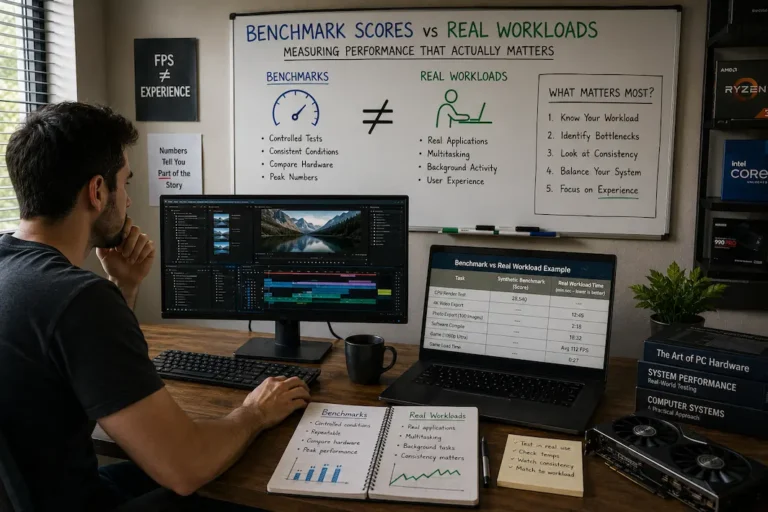
One of the biggest challenges in troubleshooting performance issues is the ever-changing nature of bottlenecks. Even if benchmarks indicate strong processor performance, a computer can still feel sluggish during everyday tasks because different workloads place varying demands on hardware resources.
Consider a workstation used throughout the day. In the morning, it compiles software, placing a heavy load on the processor. Later, it handles high-resolution video editing, which requires constant data transfer from storage. In the afternoon, it runs numerous virtual machines, consuming significant amounts of system memory. The hardware itself remains unchanged, yet the performance bottlenecks shift according to the specific demands each program places on the system.
Understanding this dynamic behavior helps you avoid the common mistake of looking for a single, constant cause for every slowdown.
Beyond CPU Usage
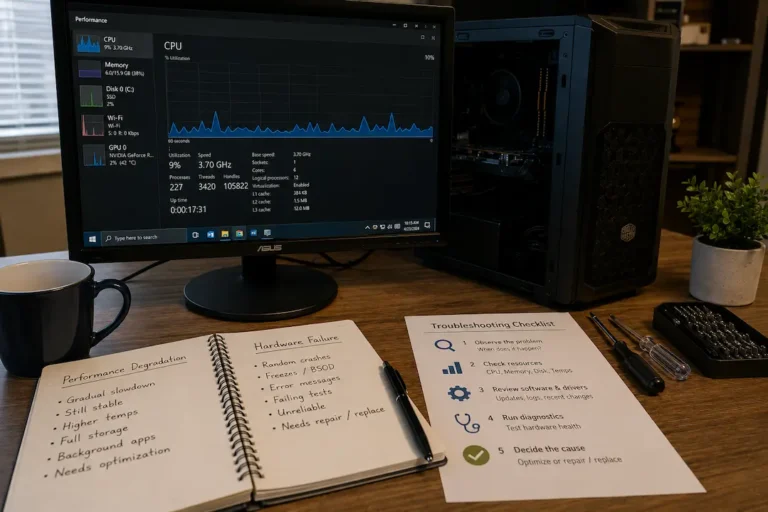
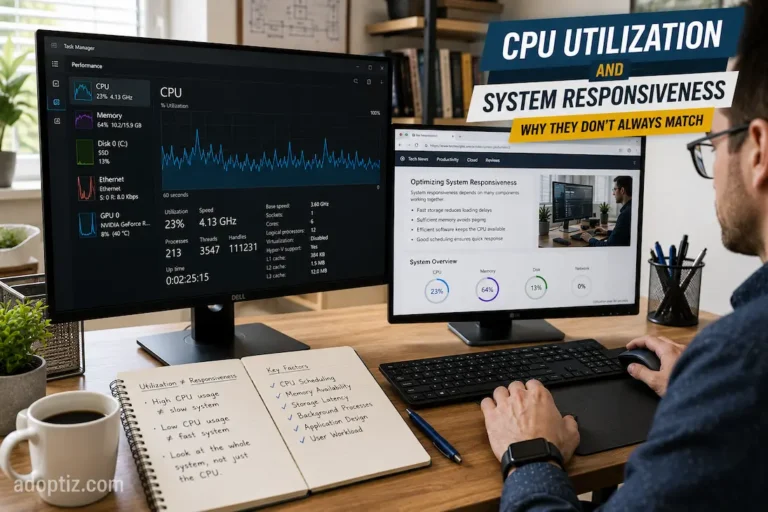
When troubleshooting performance issues, people often look at processor usage first. While this metric provides useful information, it does not always offer a complete picture. A processor with low usage might simply be waiting for data from other computer components. Conversely, a processor running near full capacity can still deliver fast performance if the workload is well-distributed.
The same applies to memory usage in isolation: it does not indicate whether a computer has sufficient resources. If you can easily load active data into memory, the computer can still function well, even if most of the installed memory is in use. In most cases, problems only arise when the operating system repeatedly has to transfer data back and forth between memory and slower storage devices.
Storage device performance follows the same pattern. Modern solid-state drives (SSDs) can achieve very high sequential transfer speeds. However, small-scale random operations, queue depth, and latency usually have a greater impact on system responsiveness during normal use. Consequently, looking at just a single specification gives you an inaccurate or incomplete picture of a product’s overall performance.
Practical Observation
While helping diagnose performance issues on office workstations, I found that users frequently focused on whichever metric happened to be highest in Task Manager. In several cases, CPU usage looked perfectly normal while a background storage process was causing long application launch times. Once the storage activity settled, the perceived “processor problem” disappeared without any hardware changes.
Easily Identify Bottlenecks in Real-World Applications
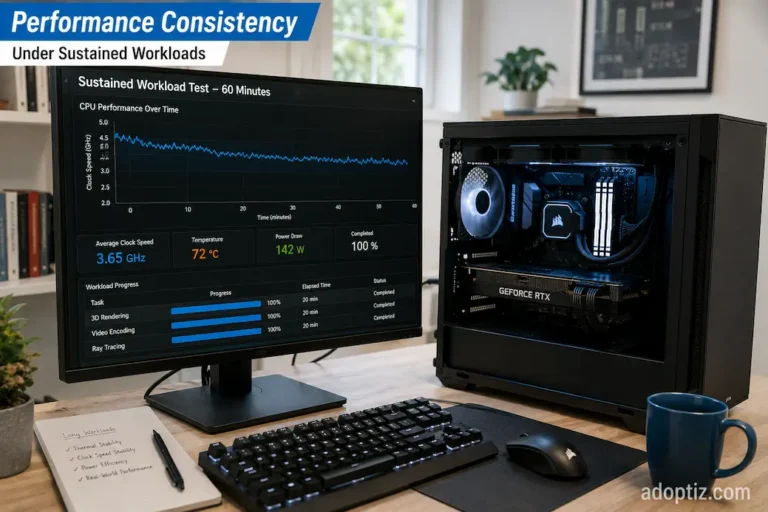
Experienced engineers generally do not upgrade hardware immediately; instead, they first pinpoint exactly when performance begins to degrade. In most cases, specific moments in time yield more useful information than simple benchmark data. If latency occurs only when the application is open, you may need to focus more on storage. If performance gradually drops during long rendering sessions, temperature might be affecting the processor’s stable operating speed. If responsiveness only decreases after opening multiple programs, memory load is likely the culprit.
In most instances, it is safer to use a process of elimination for performance analysis rather than relying on assumptions. “Which component is slow?” is not the right question. A better question is: “Which component is preventing the other components from functioning correctly?”
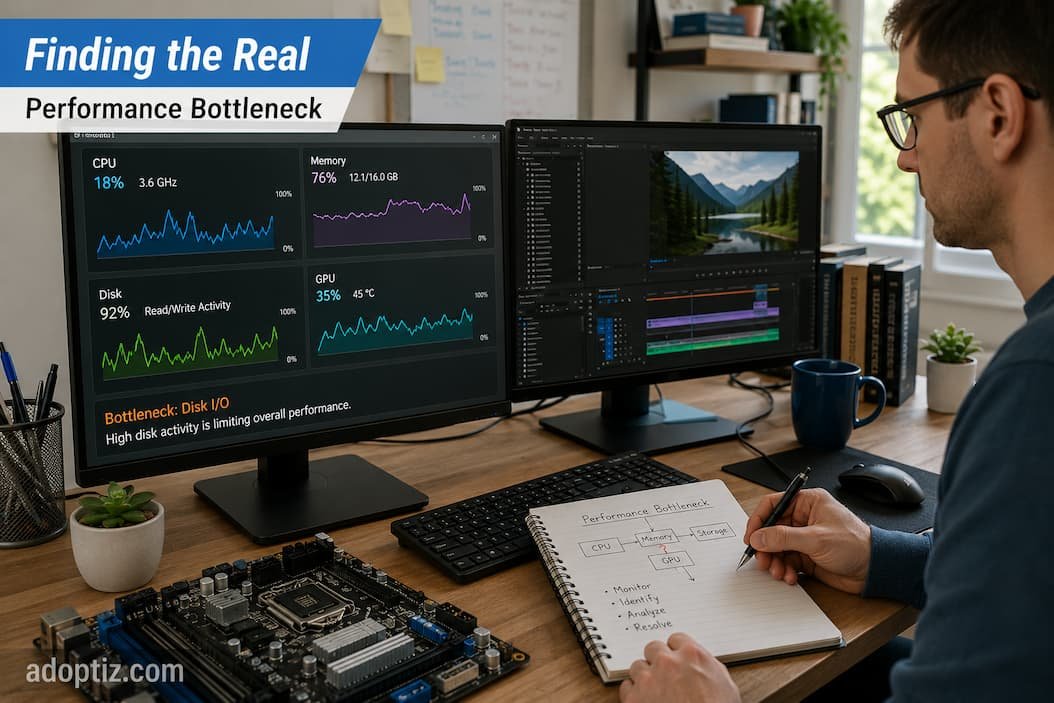
Viewing multiple graphs simultaneously can also make it easier to pinpoint the problem. Brief observations under realistic workloads often reveal patterns that synthetic benchmarks cannot show, as synthetic benchmarks test only a portion of the computation and do not attempt to simulate the complexity of everyday tasks.
Therefore, it is better to focus on relationships rather than isolated figures when concluding. Distinct patterns emerge when the processor is waiting for storage, memory is waiting for a response from the processor, or applications are competing for limited resources. Rather than memorizing performance standards, it is often more useful to learn to recognize these trends.
Why Hardware Specifications Alone Rarely Predict Performance
While hardware specifications can help you compare different products, they do not fully explain how a computer actually performs once programs begin interacting with one another. Even two systems with the same processor and memory can deliver vastly different user experiences. This is because software rarely utilizes hardware in the same way; one program might issue thousands of small storage requests, while another constantly transfers data in memory or relies heavily on graphics acceleration.
For this reason, benchmark scores should always be viewed holistically. Benchmarks assess hardware performance under specific conditions, often focusing on a single hardware component. However, most everyday computing tasks are far less predictable. Many programs compete for the same resources, background services run concurrently, and users frequently interrupt their current tasks. Even with an identical hardware configuration, bottlenecks can shift multiple times within the span of an hour.
One of the most common mistakes people make when upgrading is replacing a component simply because its specifications appear lower than those of a newer model, without first verifying whether it is actually the component limiting performance under the current workload.
Building a Balanced System
Balance is an essential element of excellent computer design. A balanced system does not rely on a single powerful component; instead, it ensures that components such as the processor, memory, storage devices, graphics card, and cooling system work together effectively. This allows tasks to run more smoothly and reduces stuttering caused by components waiting on one another.
For instance, pairing a powerful processor with slow storage devices can significantly hinder processor performance when opening applications or performing large file operations. Similarly, installing a high-performance graphics card in a system with insufficient memory or cooling can degrade hardware performance, preventing the card from reaching its full potential. To truly boost performance, upgrades should target the components that are slowing the system down, rather than simply swapping in the fastest available parts.
Maintaining this balance becomes increasingly important as workloads grow. Modern programs often utilize multiple hardware components simultaneously; consequently, maximizing the efficiency of the entire system is more important than optimizing just one component.
Performance Analysis is an Ongoing Process
Computers are not static. Over time, applications become more complex, operating systems alter resource allocation, software updates introduce new features, and storage devices gradually fill up. Even in the absence of hardware failures, a machine that appears to function perfectly today may exhibit different issues a few years down the line.
Therefore, performance analysis should be viewed as an ongoing process rather than a one-off report. Closely monitoring system performance under heavy loads yields far more useful information than relying on assumptions made months or even years ago. While it is impossible to eliminate every bottleneck, the goal is to ensure that no single limitation prevents the computer from performing its most frequently used tasks.
This perspective also encourages greater caution when considering upgrades. Users should not simply replace components because they are old; instead, they can focus on addressing issues that will genuinely improve their workflow.
Looking at Performance as a Complete System
Merely looking at processor usage or comparing hardware specifications is insufficient for identifying actual speed bottlenecks. The processor, memory, storage, graphics card, cooling system, operating system, and software all work together to execute computing tasks. If a delay occurs anywhere in this chain—even with additional resources allocated to individual components—it impacts the overall experience.
Adopting this broader perspective on performance allows for more accurate problem identification and more effective upgrades. Rather than trying to pinpoint a single culprit, it is better to observe how the system’s various components interact under different workloads. Ultimately, this type of knowledge is more valuable than simply memorizing benchmark data, as it remains valid even when the hardware changes.
As computer systems become more complex, identifying the real issues becomes easier, as components work together more effectively rather than hindering one another. In most cases, the fastest computer is not the one with the highest specifications, but the one with hardware perfectly tailored to daily tasks.