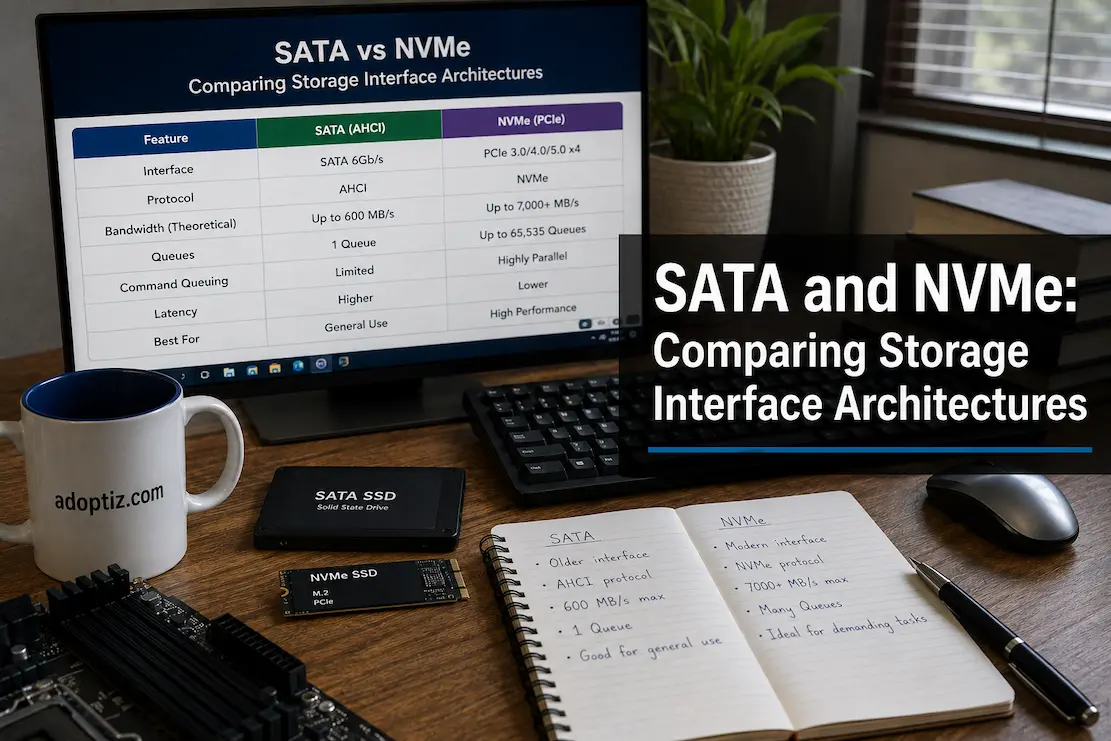
SATA and NVMe: Comparing Storage Interface Architectures
Storage technology has undergone a dramatic transformation over the past few decades. Early computer systems relied on relatively simple mechanical hard drives, making reliable data transfer between storage devices and the motherboard a major challenge.
As computer workloads became increasingly complex, storage requirements evolved accordingly. Modern applications open larger files, operating systems perform more background tasks, and specialized workloads—such as virtualization, video editing, and artificial intelligence—require faster access to vast amounts of data.
This evolution has led to a performance gap between new solid-state storage technologies and traditional storage interfaces.
SATA and NVMe represent two different approaches to meeting storage performance demands. NVMe was specifically developed for modern flash memory devices requiring faster connection speeds and lower latency, whereas SATA originated when hard drives were still the dominant storage technology.
Although both systems enable computers to access storage devices, their underlying designs are fundamentally different.
Understanding these differences makes it easier to grasp why NVMe has become the preferred interface for today’s high-performance systems and why two SSDs with similar capacities can yield drastically different performance results.
The Evolution of SATA and Its Role in Storage Systems
Serial ATA, commonly known as SATA, was introduced as a replacement for older parallel storage interfaces. Its purpose was to provide a faster, simpler, and more reliable connection between storage devices and computer systems.
When SATA became widely adopted, mechanical hard drives were still the primary storage technology. The architecture was designed around the limitations and behavior of spinning disks, where physical movement of the read/write head was the main performance bottleneck.
Because mechanical drives were relatively slow compared with modern electronics, the communication interface did not need extremely low latency or massive parallel processing capabilities.
SATA successfully improved storage connectivity by offering:
- A simpler serial communication design.
- Better cable management compared with older interfaces.
- Improved data transfer capabilities.
- Broad compatibility across computer systems.
For many years, SATA provided more than enough performance for consumer and professional computing.
However, the arrival of solid-state drives changed the situation.
Why SSDs Exposed the Limitations of SATA
Solid-State Drives (SSDs) eliminated the mechanical limitations of traditional hard disk drives (HDDs). SSDs use flash memory to store data as electrical signals, removing the need to wait for physical components to move.
This significantly improved performance but also exposed flaws in storage architecture.
Although SATA SSDs offer data access speeds far exceeding those of HDDs, they still communicate via interfaces and protocols based on outdated storage concepts.
Flash memory technology itself was not the primary obstacle; the real bottleneck lay in the communication channel between the storage device and the rest of the computer.
The Advanced Host Controller Interface (AHCI) protocol—developed in an era when storage devices operated in vastly different ways—formed the foundation of SATA.
HDDs were perfectly suited to the AHCI protocol, but the simultaneous operations flash memory could perform far exceeded the protocol’s design expectations.
Consequently, outdated communication methods actually constrained the development of faster storage technologies.
Understanding the Functions of Storage Protocols
When discussing storage performance, the focus is often on physical connections, yet communication protocols are equally crucial.
Protocols determine how the operating system and storage devices communicate, while interfaces define how data is physically transferred between components. A highway network serves as a useful analogy.
Wider roads accommodate more vehicles, but traffic rules also influence speed. Similarly, faster storage technology requires a communication protocol capable of efficiently handling a large number of simultaneous processes.
NVMe drives utilize the Non-Volatile Memory High Speed (NVMe) protocol, whereas SATA-based SSDs typically use the AHCI protocol.
One of the primary reasons NVMe storage delivers significantly better performance is precisely the difference between these protocols.
SATA Architecture: Designed for a Different Era
Although SATA architecture represented a major leap forward in replacing earlier storage interfaces, its design was constrained by the technology available at the time.
Because physical movement limits the speed at which multiple requests can be completed, hard disk drives (HDDs) typically execute processes sequentially. The AHCI architecture was designed with this characteristic in mind.
This architecture employs a fairly traditional command system to handle storage requests.
SATA SSDs still perform well for everyday tasks such as web browsing, document editing, and basic computing. Many users have reported significant performance improvements after switching from HDDs to SATA SSDs. However, the limitations of this architecture can become apparent under heavy workloads.
For applications requiring a high level of concurrent storage operations, newer designs capable of connecting more efficiently to flash memory offer distinct advantages.
The Design Philosophy Behind NVMe
NVMe was specifically designed for modern solid-state storage. It was built from the ground up around the characteristics of flash memory, rather than adapting legacy storage communication technologies. NVMe was developed to make optimal use of flash memory’s ability to perform a large number of tasks simultaneously.
The PCI Express bus (which offers significantly higher bandwidth than SATA) connects directly to this protocol.
Increasing transfer speeds is not the only goal of NVMe. It improves the entire communication process with storage by reducing unnecessary latency, allowing storage devices to operate more efficiently.
NVMe introduced a more modern approach by supporting:
- Multiple command queues.
- Greater parallel processing capability.
- Lower communication overhead.
- Direct interaction with high-speed PCI Express lanes.
This architecture better matches the way modern SSDs actually operate.
SATA vs NVMe: Architectural Differences
The difference between SATA and NVMe is not simply that one is faster than the other. They represent different generations of storage thinking.
| Feature | SATA SSD | NVMe SSD |
|---|---|---|
| Original design purpose | Mechanical and early solid-state storage | Modern flash storage |
| Communication pathway | SATA interface | PCI Express interface |
| Common protocol | AHCI | NVMe |
| Parallel operations | More limited | Designed for high parallel workloads |
| Typical latency | Higher | Lower |
| Primary advantage | Compatibility and affordability | Performance and efficiency |
The table highlights the architectural difference, but real-world performance depends on more than specifications.
A user’s workload determines whether those architectural advantages become noticeable.
Why Higher Speed Does Not Always Mean a Faster Experience
Although NVMe SSD benchmarks are generally impressive, the differences between SATA and NVMe are not always immediately apparent.
For instance, the higher bandwidth and lower latency offered by NVMe can be extremely beneficial for professional applications or when transferring large video files.
However, since these tasks are often constrained by other system components, you might not notice a significant difference during everyday activities like opening documents, browsing the web, or checking email.
Workload characteristics influence storage performance.
A faster interface offers greater potential, but actual gains depend on how effectively the operating system and software utilize those capabilities.
Queue Management: One of the Biggest Differences Between SATA and NVMe
The way SATA and NVMe handle storage requests is one of their fundamental architectural differences. Modern computing environments usually process multiple storage operations simultaneously. Even when a user appears to be performing a single action, the operating system is often simultaneously managing numerous background tasks—such as loading applications, system updates, indexing, caching, and data synchronization.
Traditional SATA systems were designed for storage environments with significant mechanical limitations, where sequential operations were more common. Although SATA was created for older storage technologies, the AHCI protocol does allow for command queuing. However, because this communication method was not designed to handle thousands of simultaneous processes, it fails to fully leverage the parallel processing capabilities of modern flash memory. NVMe employs a new strategy that allows storage devices to manage a significantly larger number of commands across multiple queues. Since NAND flash memory can access multiple locations simultaneously—without needing to wait for one operation to finish before starting another—this design aligns more closely with the internal workings of flash memory.
This advantage is particularly noticeable in workloads such as professional content creation, database operations, virtualization environments, and large-scale computing tasks, all of which generate a high volume of simultaneous storage requests.
Latency Differences between NVMe and SATA Storage
While transfer speed is often used to measure a storage device’s performance, latency is equally important. Latency refers to the time a storage device takes to respond to a data request.
If individual requests take a long time to process, even a high-bandwidth storage device can feel sluggish. Consequently, maximum read/write speed is not the only factor influencing response time.
Because SATA SSDs eliminate mechanical movement from the storage process, their latency is significantly lower than that of traditional hard drives. However, they still require interaction and rely on an outdated design, which introduces additional processing steps.
NVMe reduces this latency by using a protocol specifically designed for solid-state storage and by communicating more directly with the PCI Express interface. The result is faster response times, especially when handling large numbers of small data requests.
This difference explains why NVMe devices generally perform faster under demanding conditions, even when the user is not transferring large files. The Importance of PCI Express for NVMe Performance
NVMe SSDs connect to the motherboard and processor via the PCI Express channel, whereas SATA hard drives rely on the SATA bus. Compared to earlier interfaces, PCI Express is designed as a high-speed, scalable technology capable of handling significantly more data.
The Shift from SATA to PCI-Express Has Revolutionized Storage Architecture
NVMe enables storage devices to connect via channels designed for rapid data exchange, eliminating the need to place flash memory behind the communication system—a requirement with mechanical hard drives.
However, the specific version of PCI Express used determines actual performance. Since the connection itself can become a bottleneck, installing a newer NVMe SSD in a system with limited PCI Express compatibility may prevent it from achieving its maximum rated performance.
This illustrates a key hardware principle: every link in the communication chain must support the required capacity.
The performance of high-speed storage devices is limited by the motherboard, firmware, and interface connections they support.
Real-World Performance: Where Users Actually Notice the Difference
Benchmark numbers often make NVMe appear dramatically faster than SATA, but real-world experiences depend heavily on the type of work being performed.
A user upgrading from a mechanical hard drive to any modern SSD will usually notice a major improvement because the biggest limitation was the physical movement of the hard drive mechanism. The difference between SATA SSD and NVMe SSD is often more subtle during everyday tasks.
Activities such as opening applications, starting the operating system, browsing the internet, and working with standard office documents may not show a massive improvement because these processes depend on multiple factors, including processor performance, memory capacity, and software optimization.
However, workloads involving continuous data movement or large numbers of simultaneous operations benefit much more from NVMe architecture.
Examples include:
| Workload | SATA SSD Experience | NVMe SSD Advantage |
|---|---|---|
| Operating system usage | Fast and responsive | Slightly faster response in some situations |
| Large file transfers | Good performance | Higher sustained transfer potential |
| Video editing workflows | Suitable for many users | Better for high-resolution projects |
| Virtual machines | Can become limited under heavy workloads | Handles multiple operations more efficiently |
| Professional applications | Good for moderate workloads | Better for intensive data processing |
The important factor is not whether NVMe is faster in theory, but whether the workload can take advantage of that additional capability.
Why SATA Still Remains Relevant
Although NVMe has become the preferred choice for high-performance systems, SATA is not an outdated technology. It continues to serve an important role because compatibility, affordability, and simplicity still matter.
Many existing computers support SATA storage but may not include suitable PCI Express connections for NVMe drives. In these situations, a SATA SSD can provide a significant upgrade over a mechanical hard drive without requiring a complete system replacement.
SATA drives are also useful for secondary storage applications where extreme speed is unnecessary. For example, a large-capacity SATA SSD may be a practical choice for storing files, backups, or general data where cost efficiency is more important than maximum performance.
The existence of a newer technology does not automatically make older technology useless. SATA continues to be valuable because it solves many storage needs effectively.
Choosing Between SATA and NVMe Based on System Requirements
The decision between SATA and NVMe should be based on the purpose of the system rather than simply choosing the technology with higher benchmark numbers.
For basic computing, office systems, older computers, and cost-conscious upgrades, SATA SSDs can still provide excellent performance. They deliver the major advantages of solid-state storage while maintaining broad compatibility.
For modern performance-focused systems, NVMe is usually the better architectural choice because it matches the capabilities of current flash memory technology.
When evaluating storage upgrades, users should consider:
- The motherboard’s available interfaces.
- The type of workload being performed.
- Required storage capacity.
- Budget limitations.
- Future upgrade plans.
A balanced system is not created by choosing the fastest individual component. It is created by selecting hardware that matches the actual requirements of the user.
The Future of Storage Interface Architecture
Storage technology will continue evolving as applications demand faster access to increasingly large amounts of data. The transition from SATA to NVMe represents a broader trend in hardware design: replacing older architectures that were adapted for previous technologies with designs created specifically for modern requirements.
Future storage systems will likely focus on reducing latency even further, improving efficiency, and creating better integration between storage, memory, and processing components.
The shift from SATA to NVMe was not simply a speed improvement. It represented a change in how storage devices communicate with computers.
As workloads become more complex, storage architecture will continue playing a major role in overall system performance.
Final Thoughts
SATA and NVMe represent two different generations of storage engineering. SATA was highly successful because it provided a reliable and compatible solution during the era when mechanical drives dominated computing. However, the rise of flash storage created new requirements that older architectures were not designed to handle.
NVMe addressed these limitations by creating a storage communication model built around the strengths of modern SSD technology. Its lower latency, improved parallel processing, and direct PCI Express connection allow it to deliver significantly higher performance in demanding workloads.
The most important difference between SATA and NVMe is not simply speed. It is the architecture behind how data moves between storage and the rest of the system.
Understanding that difference helps users make better hardware decisions based on real needs rather than relying only on specification numbers.