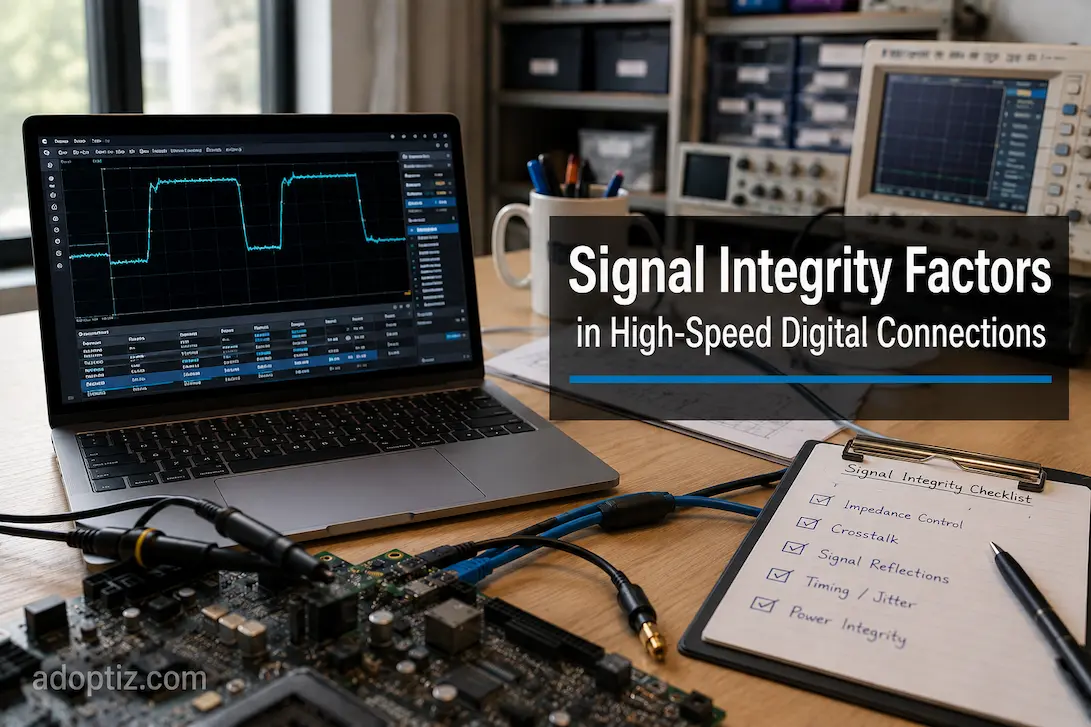
Signal Integrity Factors in High-Speed Digital Connections
Modern computing performance depends heavily on the ability to move data accurately between different components. A processor communicates with memory, graphics hardware transfers visual information, storage devices exchange large volumes of data, and networking systems continuously transmit information across complex pathways.
When people evaluate hardware, they often focus on specifications such as bandwidth, clock speed, and transfer rates. However, those numbers only describe what a system is theoretically capable of achieving. The actual performance depends on whether the electrical signals carrying that information can travel reliably from one component to another.
This is where signal integrity becomes a critical engineering factor.
Signal integrity describes the quality of electrical signals as they move through a communication path. In simple terms, it determines whether the signal arriving at the receiver still accurately represents the information that was originally transmitted.
At low speeds, small electrical imperfections may not create noticeable problems. At modern high-speed data rates, however, even minor distortion can affect reliability, performance, and compatibility.
Why Signal Integrity Matters More in Modern Hardware
The growth of computing performance has created a difficult engineering challenge. Every new generation of hardware attempts to move more information in less time while also reducing its physical size and power consumption.
A connection that worked perfectly at an older speed may not behave the same way when pushed to significantly higher frequencies.
The physical environment through which electrical signals travel affects their behavior. The pathway is not simply a passive route between two points. Circuit board traces, cables, connectors, and other components influence the behavior of the signal.
As transmission speeds increase, engineers must consider factors that were previously less significant:
- How quickly a signal changes state.
- How much energy is lost during transmission.
- Whether nearby signals interfere with each other is also a consideration.
- Whether timing remains accurate at the receiver is also a concern.
The challenge is not only creating faster interfaces. The challenge is creating interfaces that remain reliable while operating at those speeds.
Digital Data Travels Through Real Electrical Systems
Digital systems are often explained using simple binary concepts: information exists as either a one or a zero. While this model is useful for understanding computing logic, the physical transmission of that information is much more complex.
A digital signal is represented by an electrical waveform. The transmitter generates this waveform, it travels through a physical pathway, and the receiver interprets the result.
During that journey, the signal can change.
The waveform arriving at the destination may not look exactly like the waveform that was originally sent. Electrical resistance can reduce signal strength, materials can affect transmission behavior, and surrounding components can introduce unwanted interference.
The receiver must determine whether the changed signal still represents the correct information.
Signal integrity engineering focuses on keeping these changes within acceptable limits so that communication remains accurate.
The Main Sources of Signal Degradation
Several physical effects influence the quality of high-speed digital communication. These problems do not usually exist independently; they often interact with each other and become more difficult to manage as speeds increase.
| Signal Issue | Engineering Cause | Effect on Communication |
|---|---|---|
| Attenuation | Energy loss during transmission | Weaker signals and reduced reliability |
| Reflection | Changes in electrical impedance | Distorted waveforms |
| Crosstalk | Interaction between nearby signal paths | Unwanted interference |
| Jitter | Timing variations | Incorrect signal interpretation |
Understanding these issues is important because high-speed design is not about eliminating every imperfection. Instead, engineers design systems that keep these effects under control.
Signal Loss and Attenuation in High-Speed Connections
Every electrical signal loses some amount of energy while traveling through a medium. This reduction is known as attenuation.
The impact of attenuation depends on many factors, including the distance traveled, the materials involved, and the frequency of the signal.
A short connection inside a computer may experience minimal loss because careful control of the transmission path minimizes it. A longer cable connection faces greater challenges because the signal travels through more material and encounters more opportunities for degradation.
This is why high-performance cables and connectors are designed differently from basic alternatives. Supporting a higher data rate requires maintaining signal characteristics throughout the entire path.
A cable may have the correct physical connector but still fail to deliver reliable high-speed performance if its internal construction is not suitable for the required frequency range.
Signal Reflection and the Importance of Impedance Matching
One of the more complex signal integrity challenges is reflection.
When an electrical signal travels through a transmission path, it expects a consistent electrical environment. If it encounters a sudden change, part of the signal energy may bounce back toward the source instead of continuing normally.
This occurs because of impedance mismatch.
Impedance represents how a circuit responds to changing electrical signals. In high-speed systems, maintaining consistent impedance throughout the connection path is essential because small variations can create noticeable signal distortion.
A reflection can interfere with the original signal and make it more difficult for the receiving component to correctly identify the transmitted data.
Engineers manage this problem through careful design choices involving circuit board layouts, connector construction, cable design, and termination methods.
Why Circuit Board Design Directly Affects Signal Quality
The printed circuit board is not simply a platform that connects components together. In high-speed systems, the PCB itself becomes part of the communication system.
A signal traveling through a trace is influenced by the physical characteristics of that trace. Its width, spacing, surrounding materials, and relationship with other pathways can all affect performance.
This is why modern motherboards, graphics cards, and networking equipment require advanced PCB engineering.
Designers carefully analyze:
- Trace routing.
- Signal path length.
- Layer arrangement.
- Electrical reference planes.
A small design decision that has little impact in a slower system can become a major factor in a high-speed environment.
The faster the communication system becomes, the more important physical design accuracy becomes.
Why Higher Bandwidth Requires More Than Better Specifications
A common misunderstanding is that improving a communication standard automatically guarantees better real-world performance.
In reality, increasing bandwidth creates new engineering challenges. A faster interface requires the entire transmission system to support that speed, including the transmitter, PCB design, connectors, cables, and receiving hardware.
This is why two systems using the same standard may deliver different results depending on how well each manufacturer implemented the technology.
High-speed communication is ultimately a balance between theoretical capability and practical engineering.
The goal is not simply to move more data. The goal is to move that data accurately, consistently, and reliably.
Crosstalk, Noise, and Interference in High-Speed Systems
As hardware becomes faster and more compact, multiple signals must often travel through extremely small spaces at the same time. A modern motherboard may contain many high-speed pathways operating alongside each other, creating an environment where electrical interaction becomes difficult to avoid.
One of the most common challenges is crosstalk. This occurs when the energy from one signal pathway influences another nearby pathway. The affected signal may experience unwanted changes that reduce the accuracy of data transmission.
The risk of crosstalk increases as signal speeds rise because high-frequency signals create stronger electromagnetic interactions. A design that performs well at one generation of technology may require significant improvements when a newer, faster interface is introduced.
Engineers manage this challenge through careful physical design rather than relying on a single solution. The placement of traces, spacing between signal paths, grounding techniques, and shielding methods all contribute to reducing unwanted interference.
This is one reason why high-performance hardware requires much more than simply connecting faster components together. The communication environment itself must be engineered.
Timing Accuracy and the Problem of Jitter
Signal integrity is not only concerned with whether a signal maintains enough strength. Timing accuracy is equally important.
Digital systems rely on precise coordination between transmitting and receiving components. The receiver must determine the correct moment to sample incoming data and interpret the signal correctly.
When timing varies unexpectedly, the problem is known as jitter.
Jitter may appear because of electrical noise, clock instability, power fluctuations, or limitations within the transmission pathway. At lower speeds, small timing variations may have little effect. At extremely high speeds, however, the available margin becomes much smaller.
This creates a situation where a signal may still appear electrically present but fail because the receiving hardware cannot determine the correct timing relationship.
Modern high-speed interfaces therefore require advanced clock management and signal correction techniques to maintain reliable communication.
The Role of Connectors and Cables in Maintaining Signal Quality
Signal integrity is often associated with internal components such as processors, memory systems, and circuit boards. However, external connections can be equally important.
A high-speed connection depends on the entire communication path. A well-designed motherboard can still experience performance limitations if the cable or connector cannot maintain the required electrical characteristics.
This is why high-speed standards often specify requirements for cables and connectors rather than only defining the communication protocol.
A connector that physically fits does not automatically guarantee that it can support the intended performance level. Internal construction, shielding, contact quality, and material selection all influence signal behavior.
For example, a cable designed for an older generation of technology may work for basic communication but fail to maintain reliability when used for significantly higher bandwidth applications.
The physical connection may look identical, but the electrical performance can be completely different.
How Engineers Test and Validate Signal Integrity
Signal integrity problems are challenging because they are often invisible during normal operation. A system may appear stable during basic tasks but fail under heavy workloads or specific operating conditions.
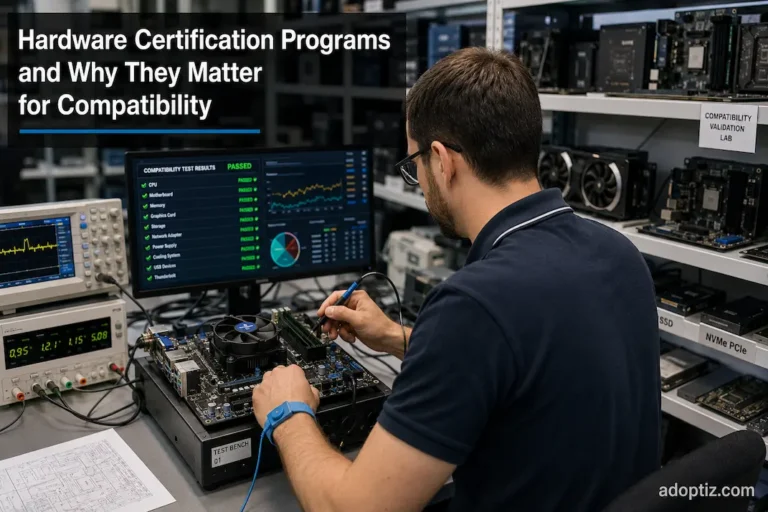
To prevent these problems, engineers perform detailed validation throughout hardware development.
Testing commonly involves analyzing:
- How waveforms change during transmission.
- Whether timing remains within acceptable limits.
- How the system behaves under different temperatures.
- Whether the connection maintains stability over extended operation.
Simulation tools are often used before physical prototypes are created. These simulations allow engineers to predict how signals may behave and identify possible weaknesses in the design.
After prototypes are produced, physical measurements confirm whether the real hardware performs as expected.
This process is especially important for advanced interfaces because fixing signal integrity problems after manufacturing can be extremely difficult and expensive.
Why Theoretical Speed Does Not Always Match Actual Performance
Hardware specifications often highlight maximum theoretical speeds, but actual performance depends on whether the entire system can handle those capabilities.
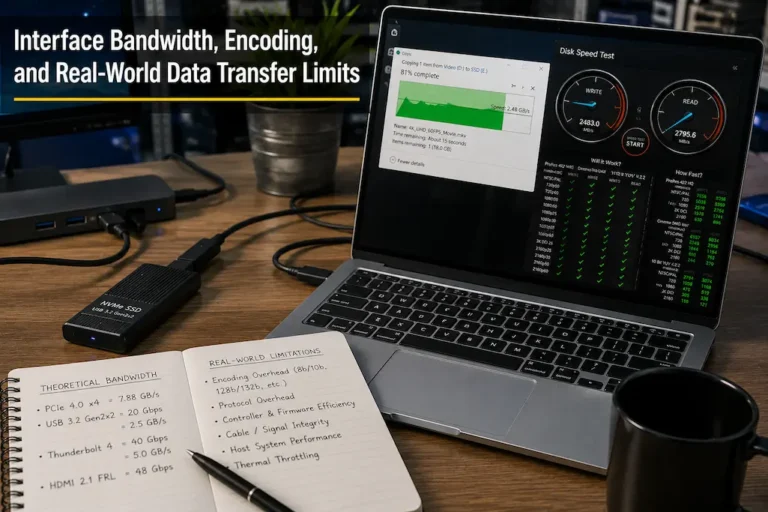
Storage devices may claim specific transfer speeds, but actual speeds depend on the interaction between drives, controllers, motherboard implementations, firmware, and physical connections.
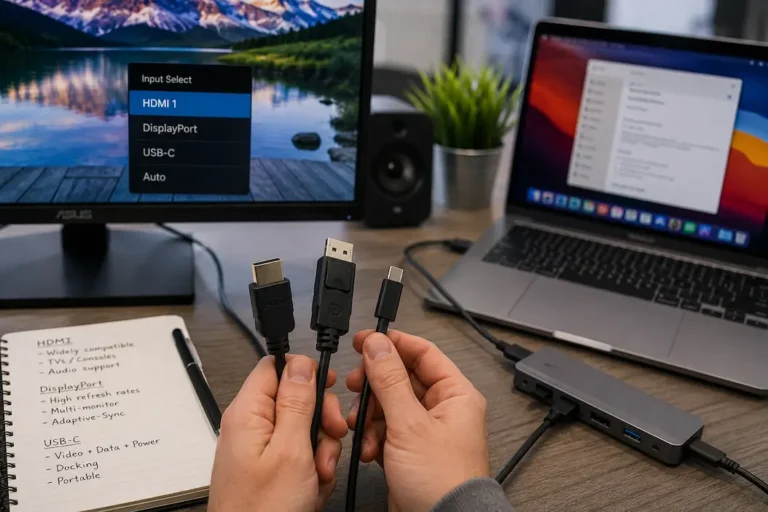
The same principle applies to display interfaces, network devices, and expansion technologies.
A weak link in the signal path can have a significant impact on the entire system.
That is why experienced engineers analyze the entire design, not just a single specification. Even the fastest components cannot compensate for limitations in other parts of the communication link.
Signal Integrity and Long-Term Hardware Reliability
Signal integrity is about more than just achieving the highest possible speed; it also affects the long-term stability of the hardware system.
Connections operating near their limits may function well under ideal conditions but become unreliable due to temperature fluctuations, manufacturing variations, or heavy loads.
Maintaining high signal quality improves operational margins. This means the system is better able to withstand the routine changes that occur during daily use.
For consumer devices, this enhances system stability and prevents unexpected issues. Communication failures can disrupt critical workloads in professional and enterprise systems.
Simply pushing component performance to theoretical limits is insufficient for developing reliable hardware. Rigorous design is required to ensure long-term performance stability.
The Future of Signal Integrity Engineering
As computer systems process larger volumes of information, graphics workloads become more complex, artificial intelligence applications multiply, and the number of connected devices grows, the demand for faster connectivity will persist.
However, higher speeds also bring physical challenges that cannot be solved by software alone.
Future developments may include the use of superior materials, more precise simulation methods, improved manufacturing processes, and more advanced signal correction technologies.
Engineers will continue to explore ways to transmit more data through fewer physical channels while maintaining accuracy and reliability.
Alongside faster processors and greater storage capacities, ensuring clear and reliable communication between all components is crucial for future computing performance.
FAQs
Why do two devices with the same interface perform differently?
Communication standards define common specifications, but manufacturers may implement them using different technologies. Decisions regarding PCB design, component quality, firmware, and signal integrity all influence overall performance.
Can signal integrity issues cause intermittent hardware failures?
Yes. Poor signal quality can lead to unpredictable behavior, especially under heavy loads. These issues can be difficult to diagnose because the hardware may function normally under lighter loads.
Why are design flaws more common in high-speed connections?
High-speed signals transition more rapidly and have tighter timing margins. Minor electrical issues that are insignificant in older systems can become major limiting factors in new technologies.
Is signal integrity critical only for expensive hardware?
No. Signal integrity affects all digital systems, but its importance grows with communication speeds and system complexity.
Conclusion
Signal integrity is one of the fundamental engineering aspects of modern computers. Users typically see only a device’s final specifications; however, these specifications rely on the ability of electrical signals to be transmitted accurately within complex physical environments.
Every step in the communication process influences the final result. Printed circuit boards, connectors, cables, power systems, and receiving components must work together to ensure reliable data transmission.
As technology advances toward higher speeds and smaller dimensions, signal integrity becomes increasingly critical. The future of hardware innovation depends not only on faster connection speeds but also on ensuring that these connections are accurate, reliable, and stable.