Error Detection, Error Correction, and Silent Data Integrity Risks
Most hardware errors are obvious. A computer crash, a faulty storage device, or an application that freezes and displays an error message immediately signals that something is wrong. While these malfunctions are inconvenient, they offer a key advantage: clarity. Users can begin investigating the problem immediately.
Errors that leave no clear trace are difficult to identify. For example: the state of a single bit changes during data transfer within memory; a calculation result is incorrect, possibly due to corrupted data; or a generated file contains minor errors that go unnoticed for months. The system continues to function normally, no warnings appear on the screen, and the corrupted data might be backed up, copied, or shared before anyone notices.
That is why data integrity is of paramount importance in the modern computing world. When processors perform billions of operations per second and memory systems handle vast amounts of information, preventing errors is just as important as increasing speed. Modern hardware is equipped with systems to identify faults, automatically correct some of them, and reduce the risk of being misled by incorrect information—rather than simply assuming that every electrical signal is perfect.
Not Every Error Leads to a System Crash
When people think of computer errors, they often picture major malfunctions: blue screens, sudden restarts, or applications failing to launch. In reality, many data errors do not immediately cause system crashes. Instead, they affect only a small fraction of the processed information.
Imagine a spreadsheet containing millions of numbers used for financial analysis or scientific research. A faulty bit changes one of the values. The spreadsheet opens fine, calculations proceed, and the operating system reports no issues. Yet, the final result may contain an error that existed long before anyone noticed it.
This is why silent data corruption is so difficult to remedy. Unlike obvious hardware problems, there may be no discernible evidence linking the erroneous result to the moment the error occurred. By the time the problem is discovered, the affected data may already have been reused for reports, system backups, or subsequent tasks.
For an average PC, this risk is usually low; however, as workloads increase and the volume of information processed by computers grows, even rare errors become statistically significant. Data centers processing petabytes of data daily or research institutions running large-scale simulations naturally place far greater importance on data integrity than a home computer processing a small number of documents.
Where Data Errors Can Originate
Data passes through far more hardware than many users realize. Before a file is saved or a calculation is completed, information may travel through the CPU cache, system memory, storage controllers, buses, communication interfaces, and storage devices. Any alteration, however minor, can lead to unexpected errors.
Although most hardware today is highly reliable, it is not without flaws. Data can become corrupted during storage or transmission due to electrical noise, manufacturing variations, component aging, unexpected environmental factors, or even natural radiation. While these events are rare, they have been extensively studied because they can have a significant impact on systems requiring absolute accuracy.
It is important to note that not all errors are caused by hardware failures. Software issues, uncontrolled overclocking, faulty drivers, and interruptions to storage processes can also lead to data corruption. Ensuring information integrity requires attention to both hardware reliability and software correctness. Never assume that hardware or software reliability alone guarantees the integrity of information.
Detecting Errors Before They Escalate into Major Problems
The first step in preventing data corruption is identifying that an error has occurred. Error detection technology is designed for this purpose. The system does not assume that information remains unchanged during storage or transmission; instead, it adds extra information to verify that the original data has not been altered.
A well-known example is downloading files from the internet. Many software vendors include checksums or cryptographic hashes in their installation packages. Once the file has been downloaded, the verification software compares the calculated value with the published value. If they do not match, it is almost certain that the file was altered or corrupted during storage or transmission.
The same principle applies to all modern computers. Storage devices verify the data they write, network protocols verify the data they transmit, and operating systems employ dozens of verification techniques capable of detecting unintended changes before mistaking corrupted data for valid data.
However, detection is only part of the problem. While identifying errors is useful, operations usually have to be halted—or data re-requested—if the system cannot recover the original information.
Error Detection Without Correction
Error detection is suitable when corrupted information can easily be retransmitted or reconstructed. For instance, if a network packet fails an integrity check, the receiving system can request a new copy without needing to attempt to recover the lost information.
This is highly advantageous for communication, as backup transmission schemes are usually available. However, this method is less suitable when the corrupted data exists only in memory or when there is no readily available recovery method.
When Systems can Self-Repair Errors
Some computing environments require more than just error detection, as halting processes is impractical or extremely costly. Scientific simulations can take days, corporate databases must be available 24/7, and servers typically handle thousands of simultaneous requests. Reliability would be severely compromised if these workloads had to be restarted every time a recoverable data error occurred.
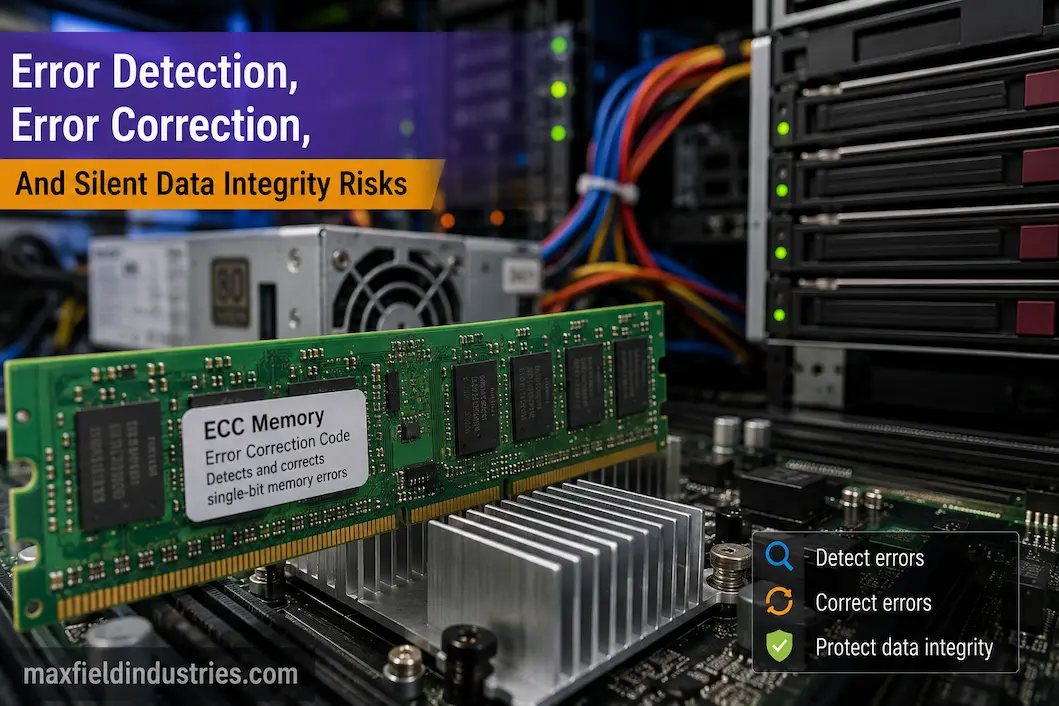
Engineers use error-correction systems for these scenarios. These systems can actually repair certain types of corrupted information, rather than simply reporting that a problem exists. The best-known example is error-correction memory, also known as ECC memory. ECC memory works by storing extra checksum information alongside user data, allowing the memory controller to detect and automatically correct single-bit errors before they reach the running software.
The recovery process is usually so fast that the application remains unaware of it. From the operating system’s perspective, the requested data arrives correctly; the system remains stable, the data stays intact, and the workload is unaffected.
This capability offers significant advantages. Error detection answers the question: “Has something changed?” Error recovery goes a step further. It addresses the question: “Is it possible to restore the original information without disrupting the user?”
Silent Data Corruption
Perhaps the most concerning aspect of data integrity issues is that not all errors are immediately apparent. Not all corrupted files are inaccessible, and not all altered calculations are obviously impossible. In many cases, erroneous data appears completely normal, making it difficult to distinguish from valid information. This fundamentally distinguishes silent data corruption from hardware failures. When a storage device fails or an application crashes, the user notices that something is wrong. Silent corruption, however, provides no warning. The system continues to run, backups may faithfully preserve the corrupted data, and subsequent programs may inadvertently execute using the erroneous data.
The consequences depend largely on the workload. Minor corruption in a temporary file used by a media application might go unnoticed, whereas similar corruption in a financial database, an engineering model, or a scientific dataset could influence decisions long after the incident. Although such incidents are relatively rare, this does not mean we can ignore their significance. In the professional computing world, their impact often depends more on where they occur than on how frequently they happen.
Data Protection Requires Multiple Technologies
No single element can fully guarantee data integrity. Modern computers employ multiple layers of protection, each designed to handle different types of errors under varying conditions.
Storage devices verify their integrity when reading and writing information. File systems use consistency techniques to reduce the risk of data corruption during unexpected interruptions. Some memory controllers can even detect and correct certain errors before a program accesses corrupted data. More advanced protection measures include backup techniques, redundancy, and periodic verification to restore data should corruption be detected at a later stage.
Each mechanism targets a different phase of the data lifecycle. These safeguards are not mutually exclusive but rather complement one another, reducing the likelihood that minor errors will escalate into major reliability issues. This layered approach to protection is one reason why modern computer systems remain reliable, even when processing vast amounts of data per second.
Tailoring Protection Levels to Workload Importance
Not all computers require the same level of protection. While the probability of errors may be low across many systems, the consequences of failing to detect an error can vary drastically.
The reliability requirements for a home computer used for web browsing, watching movies, and basic office tasks differ significantly from those of a server hosting corporate data or a workstation processing research data. Systems that run long-term simulations, manage corporate databases, support virtualization platforms, or handle archiving typically prioritize processes that ensure data integrity, as even isolated failures can have long-lasting consequences. This difference also explains why technologies such as ECC memory are common in workstations and servers, rather than in all consumer desktop computers. The goal is not merely to increase system speed, but also to reduce the risk of hardware errors silently corrupting critical or irreplaceable information over extended periods.
Therefore, robust security involves acquiring the most advanced hardware and conducting risk assessments.
Reliability is Just as Important as Performance
Speed, responsiveness, and throughput are standard metrics for computer performance, yet when assessing reliability, a crucial question remains: can we trust the results? What is the value of a system capable of rapidly performing complex calculations if one cannot be certain that the generated information is correct?
Consequently, data integrity remains a key objective in modern computer design. Error detection involves identifying unexpected changes before corrupted data is accepted without inspection. Error correction goes a step further, automatically recovering from many errors and allowing the system to continue functioning without compromising reliability. Together, these technologies reflect a significant technical reality: despite relatively reliable hardware, no electronic system can entirely avoid rare errors.
As the use of computer technology expands into artificial intelligence, scientific research, large-scale cloud infrastructure, and increasingly data-intensive applications, ensuring the authenticity of information becomes just as important as increasing processing speed. Reliable computing refers not only to the speed at which a system delivers results but also to the confidence placed in those results—specifically, that they faithfully represent the data upon which they are based.