Broadcast Domains and Collision Domains in Modern Networks
Improper network segmentation leads to inefficiency. Too many devices competing for communication bandwidth slow down response times, increase network traffic, and complicate troubleshooting. Modern networks address these issues by managing data flows between devices. Multiple devices often confuse broadcast domains and collision domains by sharing network resources. The distinction lies in the fact that they describe different traffic behaviors: collision domains focus on devices competing for data transmission, whereas broadcast domains define the scope of broadcast messages.
Ethernet Collision Domains
Devices within a collision domain can interfere with each other’s transmissions. When two devices transmit data over the same medium, signals can collide, resulting in data loss. Early Ethernet networks commonly relied on shared cables and hubs; these environments utilized a single collision domain for all connected devices. If one computer transmitted data, others had to wait. If two devices transmitted simultaneously, a collision would occur, requiring them to retransmit after a random interval.
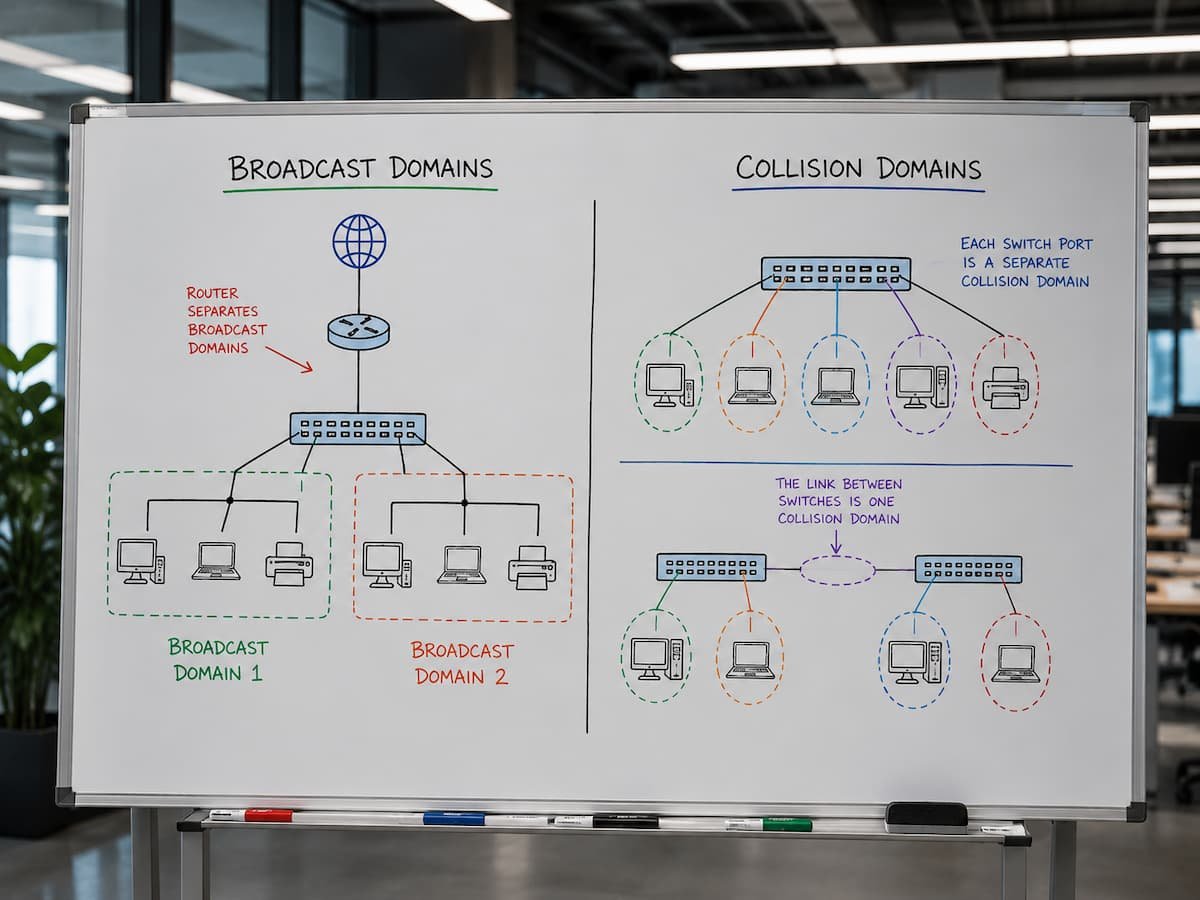
The CSMA/CD protocol manages this process. Devices listen before transmitting data and detect collisions. Although this method is effective, it becomes inefficient as networks grow. In modern networks, hubs are being replaced by switches, thereby eliminating collisions. Network switches separate communication between devices. Each switch port becomes a collision domain, allowing multiple devices to communicate independently of one another. For example, if a computer on port 1 sends data to a server on port 2, another computer on port 3 can communicate independently. Switches handle these interactions separately, rather than forcing all devices to compete for the same channel.
How Broadcast Domains Work
A broadcast domain is a group of network devices that receive the same broadcast message. Broadcast traffic reaches numerous devices because the sender either does not know the destination device or intends for all devices to receive the information. A typical example is a device searching for network resources. When a computer needs information, it can send a message to other devices. Every device within the broadcast domain receives the message.
While broadcasting is useful, excessive broadcasting can reduce network efficiency. More devices consume more bandwidth processing messages that may not be relevant to all of them. Switches do not segment broadcast domains the way they do collision domains; standard switches forward broadcast traffic to all devices across all network segments. Networks require routers or VLANs to segment broadcast domains. A company might have hundreds of employees sharing the same physical switch infrastructure. The organization can create separate VLANs to place users into different broadcast domains based on departments, security requirements, or network constraints.
The Key Difference Between Broadcast Domains and Collision Domains
The simplest way to understand the difference is to consider the type of problem each concept describes. A collision domain is about devices competing to transmit data. A broadcast domain is about devices receiving broadcast messages.
| Feature | Collision Domain | Broadcast Domain |
| Main concern | Devices interfering during transmission | Devices receiving broadcast messages |
| Common device that separates it | Network switch | Router or VLAN configuration |
| Common issue | Transmission conflicts and delays | Excessive broadcast traffic |
| Modern relevance | Mostly reduced through switching | Still important for network design |
Understanding this difference prevents a common misunderstanding: adding switches reduces collision problems but does not automatically reduce broadcast traffic. A network can have many separate collision domains while still operating as one large broadcast domain.
This distinction is important when designing networks. Improving one area does not always solve problems in another. A network may have excellent switching performance but still experience unnecessary broadcast traffic if it does not properly segment itself.
How Modern Networks Control Broadcast and Collision Problems
The core of modern network design therefore lies in building efficient communication channels. Switches, routers, and VLANs work together to regulate data flow and prevent excessive network congestion. Switches reduce collision domains. Each connected device has an independent communication line that supports full-duplex communication, allowing it to send and receive data simultaneously. Routers divide broadcast domains by limiting the transmission of broadcasts between different networks. This places limits on the propagation paths of broadcast messages.
VLANs offer a higher level of isolation. They enable network administrators to create multiple logical networks using the same physical switch hardware. By sharing the infrastructure, employees, visitors, and security systems can operate within separate broadcast domains. Network segmentation not only improves performance but also enhances security by reducing the need for inter-device communication; managing access rights becomes far more difficult when all devices belong to the same large network.
Why These Concepts Remain Relevant Today
Although the concept of collision domains is less immediately apparent in today’s switched networks, the underlying principles remain crucial. A deep understanding of how devices share resources reveals the impact of network design decisions on performance. The concept of broadcast domains remains essential as companies manage massive networks with thousands of connected devices. Unoptimized broadcast boundaries can lead to excessive traffic and increased network management complexity.
These concepts can also help newcomers understand broader networking topics, such as VLANs, subnetting, routing, and network security. This forms the basis for understanding why networks are segmented into smaller parts rather than functioning as a single, large connection. A well-designed modern network is more than just a collection of connected devices; it is a well-organized system in which traffic is effectively managed, communication lines are optimized, and unnecessary activity is minimized.
FAQs
1. Do collision domains still exist in modern networks?
Yes, but they are generally much smaller than in older Ethernet networks. Modern switches provide a separate collision domain for each port, making collisions far less frequent compared to traditional hub-based networks.
2. Does a switch divide broadcast domains?
Switches do not typically separate broadcast domains. Broadcast messages are forwarded within the same VLAN. Routers or VLAN segmentation are used to create distinct broadcast domains.
3. Why are broadcast domains important for security?
Smaller broadcast domains mean less unnecessary communication between devices and easier implementation of security measures. This helps network administrators better isolate sensitive systems and manage access rights.
4. Are collision domains still relevant for Wi-Fi networks?
The difference between wireless networks and wired Ethernet is that devices in a wireless network share radio frequencies. Wireless networks do not fully apply the classic collision domain model, but they do share communication resources and therefore require careful management.