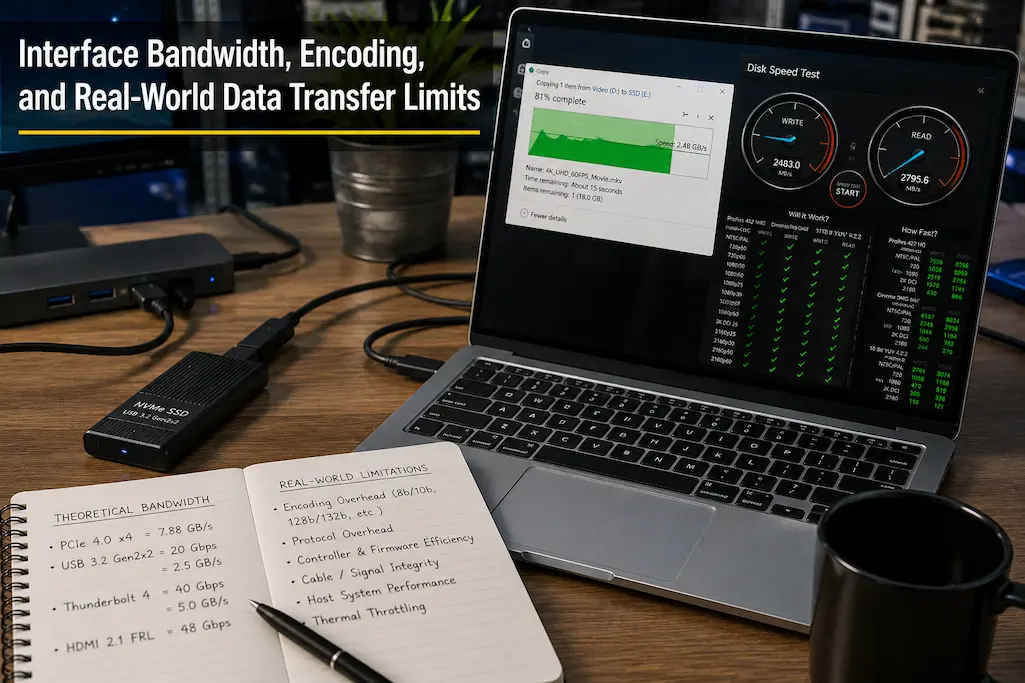
Interface Bandwidth, Encoding, and Real-World Data Transfer Limits
Interfaces capable of transmitting vast amounts of data per second are crucial for modern computer systems. Whether for networking, storage, graphics processing, or external devices, manufacturers typically cite bandwidth as a key performance metric. While higher bandwidth figures imply faster transmission speeds, the reality behind these numbers is far more complex.
An interface’s theoretical capacity under ideal conditions is represented by the maximum bandwidth listed in its specifications. However, this does not accurately reflect the amount of data actually transmitted during normal operation. Numerous technical factors—including encoding techniques, protocol overhead, error handling, controller efficiency, and the performance of the connection hardware—can create a gap between the rated value and actual performance.
This discrepancy explains why two interfaces with similar bandwidth ratings can yield different results, why the actual usable capacity of a display interface may fall short of the raw signal rate, and why storage devices might not achieve their connection’s maximum speed.
To understand an interface’s performance, one must look beyond the rated value alone. The true capacity is determined by the efficiency with which a connection converts its raw transmission capability into a reliable, usable data stream.
Bandwidth Represents Capacity, Not Actual Data Transfer
Bandwidth refers to the amount of data a communication link can transmit within a given timeframe. It does not guarantee actual performance but provides an estimate of expected capacity.
To grasp this distinction, imagine an interface as a transportation system. Although a highway is designed to accommodate a specific number of vehicles per hour, other factors—such as traffic management, road conditions, and necessary support systems—ultimately determine how many vehicles reach their destination.
A similar principle applies to digital interfaces.
A connection transmits more than just the user’s actual data; it must also manage the data required for communication between devices. This includes data structures, error detection systems, control data, and synchronization signals.
These processes consume a portion of the available bandwidth.
Consequently, an interface’s effective information transfer capacity is always lower than its theoretical maximum. Engineers must therefore assess not only the volume of data a connection can transmit but also the utilization rate of that capacity.
The Difference Between Bandwidth and Throughput
Bandwidth and throughput are closely related concepts, but they describe different aspects of communication performance.
Bandwidth refers to the maximum transfer capability of an interface. Throughput refers to the actual amount of useful data successfully transferred after accounting for communication requirements and system limitations.
A connection may advertise a high bandwidth rating, but the final throughput depends on several additional factors. A portion of the connection’s capacity may be used for managing communication, while another portion may be limited by the hardware connected to it.
The relationship can be simplified as:
Raw Interface Capacity → Communication Overhead → Usable Data Throughput
This distinction is important because many performance misunderstandings come from comparing a theoretical bandwidth figure directly with real application results.
For example, a storage device connected through a high-speed interface may not reach the interface’s maximum throughput because the storage controller, memory technology, or internal processing becomes the limiting factor.
The interface provides the pathway, but the entire system determines the final result.
Why High-Speed Interfaces Need Encoding
As communication speeds increase, transmitting digital information reliably becomes more difficult. At lower speeds, systems can use simpler signaling methods, but modern interfaces operate at levels where even small signal problems can affect data accuracy.
Encoding helps solve these challenges by changing how information is represented during transmission.
Instead of sending raw data directly, interfaces use carefully designed encoding methods that improve communication reliability. These methods help devices maintain synchronization, detect problems, and correctly interpret incoming signals.
However, encoding introduces a trade-off.
The transmitted signal contains not only user data but also additional information required to maintain reliable communication. This means some of the interface’s available bandwidth is used for transmission efficiency rather than directly carrying files, images, or application data.
The purpose of encoding is not to increase the amount of user data transferred. Its purpose is to make high-speed communication possible without sacrificing reliability.
Encoding Efficiency Affects Real-World Performance
Different generations of hardware interfaces often improve performance through better encoding techniques, not only through higher signaling speeds.
An older interface may require a larger percentage of its available capacity for communication management, reducing the amount of bandwidth available for useful data. A newer interface may use a more efficient encoding approach, allowing a greater portion of its capacity to contribute directly to data transfer.
This means two interfaces with similar raw signaling rates may not provide identical real-world performance.
The efficiency of the transmission method influences how much of the connection’s potential becomes available for actual workloads.
A simplified comparison:
| Interface Characteristic | Effect on Performance |
|---|---|
| Higher raw signaling rate | Increases maximum possible capacity |
| More efficient encoding | Allows more capacity for useful data |
| Greater protocol overhead | Reduces usable throughput |
| Better hardware implementation | Improves practical results |
The important point is that interface evolution is not only about increasing speed. It is also about improving efficiency.
Protocol Overhead Reduces Available Bandwidth
Encoding is only one reason real-world transfer speeds differ from theoretical values. Communication protocols also require additional bandwidth to organize and manage data transmission.
A protocol defines how devices communicate. It controls how information is divided, transmitted, verified, and reconstructed by the receiving system.
Without these processes, high-speed communication would become unreliable because devices would have difficulty determining whether information arrived correctly.
Protocol overhead may include:
- Data management information.
- Error checking.
- Communication commands.
- Synchronization details.
These elements are necessary for dependable operation, but they reduce the amount of bandwidth available for direct user data.
This is why a connection cannot dedicate its entire advertised capacity to transferring files or displaying images. A portion of its resources is always reserved for maintaining the communication process itself.
Why Real Hardware Rarely Reaches Maximum Interface Speeds
Even when an interface provides high bandwidth and efficient communication methods, the connected components may prevent the system from reaching theoretical limits.
A connection works as part of a complete data path. Every component involved in moving information can influence the final performance.
For example, a high-speed storage interface may connect to a drive that cannot process data quickly enough to fully utilize the available bandwidth. Similarly, a graphics interface may offer more capacity than a workload requires.
The limiting factor can exist anywhere between the source and destination:
- Processing hardware.
- Controllers.
- Memory systems.
- Firmware.
- Software implementation.
- The interface itself.
This is why evaluating only the interface specification can create unrealistic expectations. Real performance depends on how effectively the entire system uses the available communication pathway.
Why Specification Numbers Need Context
Interface bandwidth remains an important measurement, but it should always be considered within the context of the complete system.
A higher bandwidth rating can provide greater potential, but the practical benefit depends on how efficiently the technology uses that capacity and whether the connected hardware can take advantage of it.
The difference between theoretical and real-world performance is not a flaw in interface design. It is the result of engineering decisions that prioritize reliability, accuracy, and compatibility alongside speed.
Modern interfaces are not simply designed to move more data. They are designed to move data consistently and correctly under real operating conditions.
The Role of Controllers in Limiting Transfer Performance
The interface itself is only one part of a data transfer system. Behind every connection is a controller responsible for managing communication between devices. These controllers translate commands, organize data movement, handle errors, and coordinate the transfer process.
A high-bandwidth interface cannot perform beyond the capabilities of the controllers connected to it.
This is why two devices using the same interface standard can produce different results. One may include a more advanced controller capable of processing large amounts of data efficiently, while another may use a lower-performance implementation that becomes a bottleneck.
For example, a solid-state drive connected through a modern storage interface may advertise impressive sequential speeds, but those results depend heavily on the drive controller, flash memory arrangement, thermal conditions, and firmware optimization.
The interface provides the road, but the controller determines how effectively traffic moves across it.
Signal Quality and Physical Limitations at Higher Speeds
As interfaces increase their bandwidth, maintaining reliable communication becomes more challenging. Higher transfer rates require signals to switch faster, leaving less margin for errors caused by electrical interference, distance, or physical limitations.
This is why high-speed interfaces often require carefully designed cables, connectors, and circuit layouts.
Signal quality can be affected by factors such as:
- Cable construction.
- Transmission distance.
- Electrical interference.
- Connector quality.
- Hardware implementation.
At lower speeds, these limitations may have little noticeable impact. However, as bandwidth increases, small weaknesses in the communication path become more significant.
This is also why some advanced interfaces have strict requirements for cables and operating conditions. The goal is not simply to increase speed but to maintain accurate data transmission at those speeds.
Why Application Performance Differs from Rated Speed
One of the most common mistakes when evaluating hardware is assuming that application performance is directly linked to interface speed.
In reality, programs often depend on many different system components.
Although software workloads frequently consist of many small data requests rather than large-scale, continuous transfers, storage interfaces can enable very high transfer speeds. Even with high-end graphical interfaces, the graphics processor, rendering workload, and display requirements can have a greater impact on the final visual performance.
The interface determines the amount of information that can be transferred, but the amount of information a workload needs to transfer is not determined by the interface.
This distinction explains why a faster interface can lead to a significant performance boost in some cases, while having little to no noticeable effect in others.
Real-World Examples of Interface Limitations
In many areas of computer science, there is a gap between theoretical bandwidth and actual performance.
Although fast solid-state drives (SSDs) are now used in storage systems thanks to improved interfaces, factors such as controller design, memory type, cooling, and workload duration still influence their long-term performance. A drive might achieve stunning peak speeds in short-term tests, yet its performance can vary significantly over extended periods of use.
The final output of a display system depends on resolution, refresh rate, color requirements, and the performance of the graphics hardware—even when using a connection with high maximum bandwidth.
The same principle applies to network systems. If performance is limited by other devices, protocols, latency, or the processor, even a fast network connection cannot guarantee the maximum transmission speed.
In all these cases, the interface is merely one component within a much more complex system.
Measuring Interfaces Beyond Maximum Bandwidth
Engineers evaluating interface performance rarely rely on maximum bandwidth alone. A more complete analysis considers several characteristics together.
Important measurements include:
- Sustained transfer performance rather than short peak bursts.
- Latency during communication.
- Efficiency under real workloads.
- Reliability over extended operation.
- Behavior when multiple devices share resources.
This approach provides a more accurate understanding of how an interface performs in practical environments.
A specification sheet can describe the upper limit of a technology, but testing reveals how that technology behaves when placed inside an actual system.
The Importance of Understanding Data Transfer Efficiency
Modern computing depends on moving increasing amounts of information between components. As processors, storage devices, and graphics systems become faster, communication interfaces must continue improving to prevent data movement from becoming a limitation.
However, increasing bandwidth alone is not enough.
Future interface improvements will continue to focus on several areas:
- Higher transmission efficiency.
- Better encoding methods.
- Reduced communication overhead.
- Improved error handling.
- More intelligent resource management.
The goal is not simply creating larger bandwidth numbers. The goal is ensuring that more of that bandwidth becomes usable performance.
Evaluating an Interface Properly
When comparing interfaces, the most useful question is not simply:
“Which interface has the highest bandwidth?”
A better question is:
“How efficiently can this interface deliver useful performance within this specific system?”
A complete evaluation considers:
- The requirements of the workload.
- The capabilities of connected hardware.
- The efficiency of the communication protocol.
- The limitations of the physical connection.
- The consistency of performance over time.
This approach avoids the common mistake of judging technology based only on theoretical specifications.
A well-designed interface is not defined only by its maximum speed. It is defined by how effectively it transforms available capacity into reliable, practical performance.
Conclusion
Although interface bandwidth is a key metric for communication capacity, it is merely the starting point for understanding actual performance. The performance experienced by users depends on a multitude of technical factors situated between raw capacity and available data transfer.
Encoding improves efficiency and reduces transmission error rates. Protocols utilize a portion of the available bandwidth while simultaneously ensuring communication reliability. Physical limitations, hardware components, and controllers all influence the outcome.
Consequently, modern interfaces are no longer defined solely by the gap between theoretical bandwidth and actual throughput. This reflects the challenge of transmitting vast amounts of data reliably and accurately.
As computer systems demand increasingly high connection speeds, the most effective interface designs must offer not only greater bandwidth but also smarter, more efficient methods for translating that bandwidth into actual performance.