Performance Consistency Under Sustained Workloads Instead of Short Benchmarks
People may not understand why a computer performs exceptionally well during the first few minutes of a task but then gradually slows down. The software, file size, and settings remain the same, yet the computer no longer feels as fast as it did initially. The difference between peak performance and sustained performance is a key factor to consider when evaluating computer performance.
Short-term benchmarks are ideal for testing how quickly hardware executes specific tasks in a controlled environment; however, in real-world scenarios, many tasks cannot be completed in just a minute or two. Hardware often needs to operate over extended periods for tasks such as video rendering, software compilation, engineering simulations, data analysis, and prolonged gaming sessions. In such cases, maintaining stable performance is often more important than achieving high scores during the initial minutes of a test.
Why Short Benchmarks Don’t Tell the Entire Story
Benchmarks are designed for repeatability. To enable users and reviewers to compare hardware fairly, they execute the same operations under similar conditions. While result consistency is a major advantage of benchmarks, it also means they reflect only a small fraction of a system’s actual performance.
Many benchmarks are very brief. At the start of a test, the computer and graphics card often have spare power and thermal headroom. These systems can run at high turbo frequencies for a time until temperatures rise enough to reach an equilibrium with the cooling system. Consequently, benchmark results often show the hardware operating at near-maximum capacity.
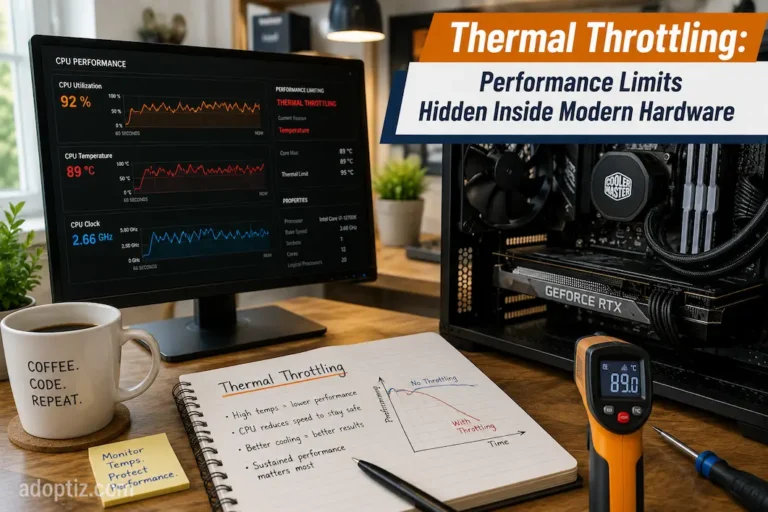
Real-world tasks behave quite differently. Over time, heat builds up within the CPU, processor, graphics card, and even the computer case itself. As time passes, the cooling system must work harder to dissipate heat, and the hardware begins operating within power and temperature limits rather than briefly hitting peak performance as it did initially. Consequently, data captured during the first few minutes may not reflect the system’s full performance capabilities.
System Performance Changes Over Time
Computers are dynamic systems; this is one reason why sustained operation under heavy load can reveal so much about performance. When running applications under heavy load, the operating environment is constantly shifting. Cooling fans spin up, temperatures stabilize, background tasks launch, and power management algorithms continuously adjust operating frequencies to strike the optimal balance between performance and energy efficiency.
These changes do not indicate a system malfunction. Modern technology is designed to adapt. The goal is not to maintain the highest possible clock speed indefinitely, but to deliver optimal long-term performance within safe operating limits.
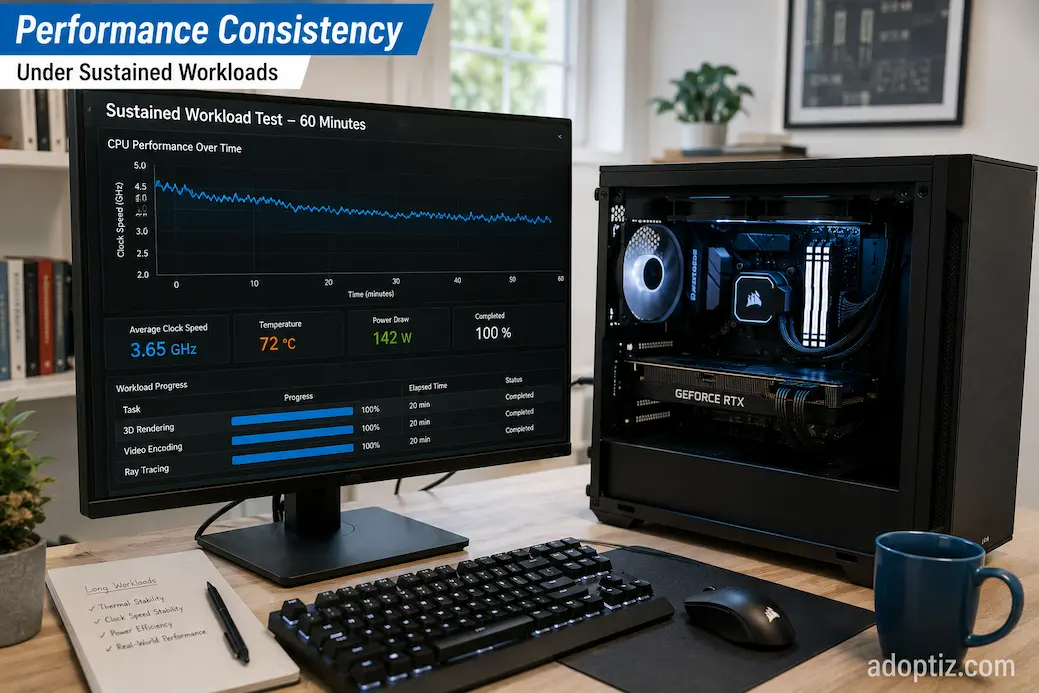
For instance, if a processor begins a rendering task at 5.4 GHz, the frequency may drop once the temperature reaches its normal operating range. If the frequency remains stable during subsequent tasks, the processor is functioning as intended. Focusing solely on the initial boost frequency fails to provide insight into how the system actually performs during most tasks.
The Importance of Stability
Consistent performance offers several practical advantages beyond benchmark scores.
Systems that maintain stable operating behavior tend to:
- Produce more predictable completion times for long workloads.
- Deliver smoother experiences during extended gaming sessions.
- Reduce noticeable fluctuations in application responsiveness.
- Better utilize available cooling capacity over time.
These characteristics may not always appear in short synthetic tests, but they become increasingly valuable during everyday professional and enthusiast workloads.
Why Some Systems Sustain Performance Better Than Others
Two computers equipped with the same processor can behave very differently during prolonged workloads. While they may produce nearly identical results in a short benchmark, differences often become apparent after twenty or thirty minutes of continuous activity. The explanation usually lies not in the processor itself but in the surrounding system.
Cooling design is one of the most significant influences. Larger heatsinks, efficient airflow, properly applied thermal interface materials, and well-designed fan curves allow heat to be removed more effectively. As a result, the processor spends more time operating near its optimal performance level before thermal limits begin influencing clock speeds.
Power delivery also contributes to sustained behavior. Stable voltage regulation helps processors operate efficiently under continuous demand, particularly during workloads that keep multiple cores active for long periods. Although users rarely notice these components directly, they play an important role in determining how consistently hardware performs over time.
Software can influence sustained performance as well. Background applications, operating system scheduling, driver optimization, and workload characteristics all affect how efficiently available resources are used once a system has been under load for an extended period.
Editorial Observation
During comparisons of several similarly configured desktop systems, I noticed that the first benchmark run often produced remarkably similar results across all of them. After repeating longer rendering and encoding workloads, however, the differences became much easier to identify. Systems with stronger cooling solutions didn’t necessarily start faster—they simply maintained their performance much more consistently as the workload continued.
Looking Beyond the Highest Number
Peak performance figures are often used to measure performance because they are easy to compare. People frequently focus on products with higher clock speeds, higher benchmark scores, and shorter completion times. While these metrics remain useful, they can cause one to overlook a quality that many professionals value most: reliability throughout the entire workload.
Imagine two workstations running the same two-hour rendering project. One workstation completes the initial stages quickly but slows down as temperatures stabilize. The other workstation, while never reaching the same peak, maintains a virtually constant speed. In a short benchmark test, the first workstation appears superior; however, the second is likely just as efficient—or even better—because its performance remains consistent throughout the entire task.
This perspective is particularly important in fields where productivity is measured in hours rather than minutes. For engineers, software developers, researchers, content creators, and data analysts, maintaining a steady workflow until a task is complete is more important than chasing the fastest possible speed.
A More Meaningful Approach to Performance Measurement
As technology advances, methods for testing computer systems continue to evolve. An increasing number of reviewers realize that a single benchmark test cannot fully capture a machine’s true performance. Many reviewers now combine comprehensive benchmarks with long-duration workload tests, subjecting the hardware to sustained loads over extended periods.
This more comprehensive approach reveals characteristics that are often overlooked in short-term tests. Once the system has run under load for a certain period and reached a steady state, it becomes easier to assess performance stability, thermal behavior, energy efficiency, and thermal management. Long-duration tests answer a more important question than a processor’s short-term speed: can it maintain strong performance after the initial speed boost?
This distinction is crucial, as many modern processors are designed to exploit temporary headroom in power consumption and temperature. While short-term boosts can improve system responsiveness during brief tasks, the ability to handle heat and power over extended periods determines performance under sustained workloads.
Choosing Tests That Match Real Usage
Effective performance tests must simulate actual computing workloads. Benchmarks designed for professional rendering are largely irrelevant for users who spend most of their time editing documents and browsing the web. Similarly, engineers running complex simulations will gain little insight from short-duration productivity tests geared toward office environments.
Long-duration tests are more useful for tasks such as software compilation, media creation, scientific computing, virtualization, and extended gaming sessions. These activities continuously test the performance of multiple components, revealing how well the processor, cooling system, memory, storage, and operating system work together over time.
When deciding which products to buy or upgrade, test results that more closely approximate real-world scenarios are more valuable.
Why Long-Term Performance Reflects Overall System Design
Consistent long-term performance is rarely the result of a single factor; instead, it reflects how well all the computer’s key components work together. For the processor, effective cooling, a stable power supply, responsive memory, and storage devices that ensure smooth data transfer are all crucial. Even if individual parameters appear optimal, shortcomings in any one area will gradually degrade overall performance.
Consequently, two systems equipped with the same processor can perform very differently when handling heavy workloads. One system might maintain consistent performance for hours, while the other gradually slows down due to temperature fluctuations or because the supporting hardware reaches its limits. These differences are not apparent if you look only at the processor specifications. This means that evaluating long-term performance helps provide a better understanding of the system’s design. It does not treat physical components as isolated entities; instead, it recognizes that long-term performance depends on how they interact in real-world applications.
Better Methods for Performance Evaluation
Short-term benchmarks remain useful because they provide precise measurements that allow for the comparison of different hardware. They establish useful technical standards and offer a clearer picture of the direction in which a product or product generation is evolving. Using benchmarks is not wrong; however, it is a mistake to believe they tell the whole story.
For many users, the most important question is whether their computer remains responsive and stable during daily use. A stable computer generally offers a better user experience during prolonged, heavy workloads than a computer that performs well only in short-duration tests.
Despite increasingly intelligent processors and demanding tasks, consistent performance remains one of the best indicators of a computer’s true capabilities. Peak performance may grab attention, but a system’s actual performance depends on its stability.